Friday, July 12, 2024

Cats - The Jellicle Ball, Perelman Performing Arts Center, New York City (July 10)

Even lovers of Andrew Lloyd Webber's 1981 musical Cats must concede that its first act especially is confusing which only underlines the problem with the through-sung musical - it's difficult to advance narrative through song. That's what all those recitatives and subtitles and program notes in opera are for. Those not enthralled by the spectacle or Webber's score have checked out in bewilderment by the third number. Cats has long since been Exhibit A for anyone disdainful of musical theatre - low-nutrition, flat-bottomed, readymade for tourists instead of the Serious Theatergoer. So when a friend invited me along to see Cats - The Jellicle Ball, a reimagining of the show told through the prism of the queer ballroom culture excavated by Paris is Burning (Jennie Livingston, 1990), I wasn't expecting much, perhaps an episode of Pose bedizened with "Memory" and a few of the peppier numbers. What I couldn't have imagined is how utterly it would overwhelm me for all of its 2.5 hours. After over forty years, with direction by by Zhailon Levingston and Bill Rauch and choreography by Arturo Lyons and Omari Wiles, Cats is finally a Great Musical. 

The reimagining is both radical and not. This is basically a production of Cats. No noticeable numbers or characters are eliminated or added. So the confusion remains, solidifying the notion that Cats is at heart a non-narrative show. The story concerns a clutter of cats vying for the chance to gain a new life in a celestial body called the Heaviside Layer. But this overall arc gets lost in the show's contest structure which gives each cat the spotlight for a number or two in an attempt to dazzle us. The genius of The Jellicle Ball is in realizing how perfectly Cats and ballroom culture work together. Drag balls are contests, not stories. They roll out categories (recall those from Paris is Burning such as Schoolboy/girl Realness, Town and Country, or Butch Queen First Time in Drags at a Ball) and a panel of judges declares a winner within each. With that structure in place, one gleaned by anyone familiar with RuPaul's Drag Race or HBO's Legendary, the audience is freed of narrative expectation. The cast aren't even cats; they're mostly Black and Latinx, mostly queer ball contenders. They're there to serve sickening looks and moves down the catwalk to get tens across the board and snatch a trophy. We are at a ball, not a diegetic event eliciting docile voyeurism, and thus, the production encourages the audience to honor the titanic talent on display with fan thworps and spontaneous hollering for an altogether immersive experience. As a gay man comfortable with jettisoning narrative and bored with distended second acts, I've never had more fun or been more moved at the theatre. 

Part of how The Jellicle Ball keeps the excitement up throughout is that every moment is suffused with the energy of the house and disco music heard at balls. This is not only a matter of undergirding the songs with an electronic dance beat; the staging and choreography emulate the very structure of disco and house music. Both related genres often rely on the break for their effectiveness on the dancefloor. The break is that part of the track where most of the elements drop out leaving only the percussion or perhaps the vocals to proceed. When the rest of the music finally returns (labeled the drop in DJ parlance), the effect can be so kinetic that dancers will wave their hands in the air, screaming and blowing whistles and ripping off their shirts in orgasmic ecstasy. A classic example is Armand Van Helden ft. Roland Clark's 1999 "Flowerz" with the break starting around 5:38 and the megaton drop occurring at 7:39 in this video.

Nowhere is this more apparent than in the opening ensemble number "Prologue: Jellicle Songs for Jellicle Cats." The song builds in intensity until the backbeat slows and soon stops, allowing the cats to sing as an angelic choir. And then the number slams right back into a fast-paced chorus as if it never left. It's a spritzy enough moment in the original. But The Jellicle Ball sets it on fire. The ensemble is gathered at the far end of the runway for the angelic chorus. And when the drop occurs, they march down the runway in Chorus Line-precision sync with choreography evoking the catwalk moves of ball culture. The effect is like watching a stream of fabulous queer bodies shoot out of a canon, surpassing even the drop in "Flowerz" in intensity. It so overwhelmed me that I could've ran to the nearest corner and crouched down to sob. I feel lucky to have witnessed it. Recognizing that this is their money shot, The Perelman Performing Arts Center has chosen a rehearsal of this very moment to advertise the show generating over a million views on Instagram and kicking off a viral dance challenge. 

Anyone still requiring a three-act structure with psychologically well-rounded characters will recoil from The Jellicle Ball. Indeed, one might even claim that the non-narrative framework robs the Black and Latinx queer characters of their chance to tell their stories. But Cats is skeletal enough that The Jellicle Ball never falls into the trap of plastic representation - inserting BIPOC representation into a structure with no BIPOC import. Because the spatiotemporal nature of Cats is so fantastical and non-specific, the Jellicle Cats can occupy it without paying fealty to a diegesis unrelated to their lives. Their stories, their critical thought, their dismantling of the master's tools occur through their bodies which can travserse and abandon space as ball participants have done with gymnasiums, rec centers, dance halls, etc. André De Shields as Old Deuteronomy says precious few words. His age-etched visage brings the past to bear on the proceedings and commands respect with nary a muscle twitch. Junior LaBeija (the queen who spells out "opulence" in Paris is Burning) as Gus sits at a sideline table during intermission, radiating fabulosity in leopard print and long gold nails. And each incredible performer speaks to us in death drops and duck walks as much as through Webber's songs.

I doubt one could apply ball to any show. Titanic or Wicked or Phantom are too localized to stave off plastic representation (although Pippin provides an enticing possibility). And I doubt The Jellicle Ball would survive a move up to Broadway. The ball effect would become diluted up in the nosebleeds of a cavernous theatre. But unsurprisingly, the show's run at the Perelman, way downtown by One World Trade Center, has been extended to August 11th as of this writing. This is my paltry attempt to make sure it doesn't stop there.

Labels: , ,

Wednesday, September 20, 2023

Sweeney Todd: The Demon Barber of Fleet Street (Lunt-Fontanne Theatre, September 17, 2023)

The performance of Sweeney Todd: The Demon Barber of Fleet Street at the Lunt-Fontanne Theatre last Sunday was the first Stephen Sondheim show to leave me underwhelmed. But I'm struggling to posit reasons why. Maybe I remain too in awe of the first Sweeney Todd I saw, the 1982 TV movie with Angela Lansbury and George Hearn as Mrs. Lovett and Todd, respectively. Maybe the leads were miscast. Annaleigh Ashford and Nicholas Christopher (filling in for Josh Groban which was why our tickets were cheaper than usual) possess gargantuan talent, especially Christopher who was dripping with sweat for many minutes after a fiery "Epiphany." But both seemed too young for the roles (as I suspect Groban is too) and neither were as rotted or scary as Lansbury and Hearn. And maybe, just maybe, Sweeney Todd pales in comparison to Company, Into the Woods, Assassins, etc. For once, a Sondheim musical bore the two negative hallmarks of a Broadway show - too long and too many ballads. Still, nothing could detract from the power of the best number - "The Ballad Of Sweeney Todd" which opens and closes the show and is reprised throughout. That's because, as always, it's an ensemble number, Broadway's greatest gift to humankind. With queerly high tenors and screeching sopranos building to near glossolalia, Sondheim skirts the edge of chaos. To quote Salieri in Amadeus, it was both terrifying and wonderful to watch.  

Grade: B


Labels: , ,

Thursday, March 02, 2023

My Fair Lady (George Cukor, 1964)

Pros:

1. Those gorgeous, eternal songs and the fecund musical universe it engendered. Read Tim J. Anderson's two chapters about the myriad recordings of the numbers and how they trained America in a new form aesthetic discernment in his terrific Making Easy Listening: Material Culture and Postwar American Recording (University of Minnesota Press, 2006). For one such spirited-and-then-some version, check out Lypsinka's take on Marilyn Maye's take on "Get Me to the Church on Time" here.  

2. The sick, gay-ass costumes and art direction of Cecil Beaton. I want never to leave the "Ascot Gavotte."

Cons:

1. The godawful, received, arbitrary, compulsorily heterosexual ending which George Bernard Shaw would've hated.

2. The length. Gawd, post-1960 Hollywood cinema makes my ass itch!

3. The direction. Cukor pulls off some elegant swirls. And I appreciate the perversity of rendering this a de facto inscription of the Broadway show. But lawd, is the camera heavy in that tumescent, Oscar-pandering, post-1960s Hollywood way! Cut! Track! Show me one (1!) fourth wall!

4. Audrey Hepburn. To state the obvious, she acquits herself admirably but Julie Andrews would've smoked her. 

Grade: B


Labels: , , , , ,

Friday, September 16, 2022

Monthly Top Ten, August 2022

1. The novels of Ivy Compton-Burnett. Cited by Sontag as part of the canon of camp, Compton-Burnett's novels are comprised almost entirely of dialogue. To borrow film terms, there are few long or even medium shots and no establishing shots. Close-ups dominate such that the reader has no clue who else may be in the same room with the characters chattering at present. They exist only as they speak, closely miked, as it were. This is the camp component. The characters, families engaged in financial squabbles with the help and select neighbors providing mordant commentary, exploit linguistic style to gain an ever-shifting upper hand. Each thesis is met with an exacting, exhausting antithesis in endless verbal skirmishes. The perceived self matters not a whit in Compton-Burnett's world. What counts is the presenting self's ability to wield language as protective armor as epitomized by this astonishing exchange from Darkness and Day (1951) between Bridget and Edmund, a married couple with children who have just discovered that they are not, in fact, father and daughter [sic]:

"We have one gain, an ordinary daily life. Did we like it so much when we had it?" 

"We shall like it now. We shall rise and speak and move in the common light of day. Our words will have their meaning. They will have none that is for ourselves. We shall not be afraid of what sounds beneath them, of what is heard through them." (164)

The tragedy here is not the threat of incest but rather the loss of a public self with which to shield oneself from convention. What then emerges across nineteen similarly styled novels published between 1925 and 1971 (I've downed three - the aforementioned Darkness and Day, 1925's Pastors and Masters, her first novel in the style, and The Last and the First, published posthumously in 1971) is not only a respect for camp as a survival strategy but a palpable intelligence behind such extreme emissions. The reader longs to get to that self underneath these battles in dialogue, an unattainable goal that ensures an obsessive drive to consume the next Ivy Compton-Burnett novel. My strong suggestion for newbies is to have Violet Powell's A Compton-Burnett Compendium (Heinemann, 1973) nearby which provides straight-forward synopses of each novel. You're going to need them.

2. Elizabeth Taylor, Angel (1957). Angelica Deverell, "too good a name to be true," indulges in no social niceties ("ignorant of convention as she is scornful of it") and cannot read sarcasm. She trusts not her senses but her idealistic imagination and reality be damned if it impinges on her dream womb. She's altogether insufferable to anyone in her orbit. And despite, if not because, of all this, she becomes a successful romance novelist. As befits someone who counts kitschmeister Frederic Leighton among her favorite painters, Angel writes novels of a gargantuan floridity. We know because Taylor provides a hilarious parody of her style (a "nay" on every page and "coruscating" attached to dozens of nouns). Critics ridicule her, editors try to curb her more rococo flourishes. But Angel holds fast and sells mountains of books. This affords her the potential to live the romantic life of her characters. Unfortunately, pesky reality has other plans. Her husband, a talentless painter named Esmé, keeps a mistress in London. The world wars are inconveniences, especially when Esmé enlists against her wishes. She pens antiwar screeds which tanks her popularity. And her palatial estate, Paradise House, devolves into a Grey Gardens. Even the peacocks she purchased fail to fan their feathers and instead shit all over her terrace. Taylor traces Angel's decline with a tart, Flaubertian irony. But she sketches Angel's uncompromising nature so indelibly that you can't help but admire the punk Barbara Cartland that results. "Always too busy writing about what she thought of as ‘nature’ to go out of doors to look at things," Angel reminds one of Peggy Gravel bitching about trees stealing her oxygen in Desperate Living (John Waters, 1977). And in her claiming that “we may all be equal in the sight of God...but we are not all equal in my eyes,” one spots Patti Smith's "Jesus died for somebody's sins but not mine" on the horizon.  

3. Angel (François Ozon, 2007). Ozon gets it. In this savvy adaptation of Taylor's novel, he gives Angel (Romola Garai) the romantic mise-en-scène she craves so much. Cheesy rear projection lets her travel around the world. Esmé is played by an irresistible Michael Fassbender. And right before Angel drops dead, she lets forth with a preposterous "I am Angel Deverell!" But no matter how hard she tries to live in one of her novels, she cannot escape her rotten personality, leaving the Harlequin romance existence forever out of reach.

 
4. Jane Bowles, Two Serious Ladies (1943). More difficult people including a Miss Goering who is “used to forcing people into conversation, her fears never having been of a social nature.” Tennessee Williams' favorite novel, Two Serious Ladies is peopled with characters who, when they aren't being mean to one another, exhibit baffling motivation. In bad decision after bad decision, Mrs. Copperfield and Miss Goering go on separate tawdry journeys, the former falling in love with a prostitute in Panama, the latter shacking up with a series of no-goodniks possibly on Staten Island. These two serious ladies are after transcendence, a going to pieces which grants them authority and daring. They meet in the last few pages but the summit yields only more insults. Alone at the end, Miss Goering fancies herself a saint. But she has no followers, a code she doesn't use, and in the last sentence, deems the matter to be "of no great importance." In short, a Fassbinder film avant la lettre.
 
5. Jonny Gators, Kodachrome 40 Super 8 reversal processing first attempt. Not good. Beach. (YouTube, 2022). Not good, indeed. Great! I learned such terms as "lomo tank" and "caffenol reversal process" from this apparent failure to develop a bit of Super 8 ("Worst roll yet, ugh"). But it turns out to be an absolutely gorgeous experimental film. "Could use some pointers at this point, I suppose." Sure, keep fucking up!
6. Diana Hubbell, "How America Embraced Aspics With Threatening Auras," Gastro Obscura (May 10, 2022). As a veteran of the jellied pork at the Ukrainian East Village Restaurant, I was hungry for this serious inquiry into the past and future of aspics. Formerly a method of food safety, aspics are now haute cuisine at finer establishments. Check out the takoyaki-inspired aspic with baby octopuses in sake-infused jelly below. But most intriguing was the suggestion that the mid-twentieth-century gelatin horrors we love to ridicule today were the product of home economics pioneers like Lillian Gilbreth and Ellen Richards frustrated at being locked out of the "masculine" realms of science. 
7. Ozark (Netflix, 2017-2022). The inability of serial television writers to take larger narrative arcs into consideration reaches its sloppy apotheosis here, one hopes. An office is blown up in season two but the destruction is completely forgotten as season three begins. No mention of clean up and never ever any indication of how such violence might impact the characters. Just keep the stay-at-homes streaming. Luckily, I stuck around for the series finale which offered an unforgiving glimpse into how the white, middle-unto-upper-class central couple of Marty and Wendy Byrde (Jason Bateman and Laura Linney) manage to retain their privilege. And helping it all go down was Julia Garner in a performance for the ages as Ruth fuckin' Langmore as my friend Charles rightfully calls her. 
 
8. The Lion King, Minskoff Theatre (September 4). Dump your second acts, Broadway! I begrudgingly admit that the spectacle held me for a good half hour. But then the story kicks in and soon, I was making common cause with the fidgety nine-year-old in front of me. And this was before intermission at which point I heard a mother tell her even younger child, "there's a whole other part." Tragic but true, kid. And yet, I did get choked up, not during the lethally dull second act but when Scar took his bow at the end. I honestly assumed everyone would boo him. Instead, he received just as much love as Simba and Mufasa. Poke fun at the musical all you want, Hell, I'll join you now and then. But no other genre has that capacity for community formation and collective regard.

9. Alfredo Jaar, 06.01.2020 18.39, 2022, video projection, sound, and fans. This installation at the 2022 Whitney Biennial evokes the National Guard helicopters flying low enough to disperse Black Lives Matters protests in Washington D.C.'s Lafayette Square before Trump's photo op in front of St. John's Church. Patrons were allowed in only at certain intervals so as to experience the five-minute video document in its full horror. But Jaar needn't have worried about diluted impact. It's the sound of the six overhead fans that made us feel the chaos of that day, a sound one could hear roaring at any point on the sixth floor of the Whitney.  

 10. The Paranoid Style: For Executive Meeting (Bar/None, 2022). At first, Elizabeth Nelson doesn't seem like your bohemian compatriot. Her music is unfashionable demo-style pop-rock. She recently dissed chattering class bands like Vampire Weekend and Arcade Fire. And worst of all, she likes golf. But if there's someone recording brainier, more boho songs, gimme their Bandcamp. Did you know that Steve Cropper played guitar on Big Star's cover of "Femme Fatale"? Did you know that the Box Tops recorded a version of "A Whiter Shade of Pale"? Do you know who Barney Bubbles was? You can learn all this and more on For Executive Meeting, Nelson's latest full-length. Oh you knew all that? OK, then how about a mind attuned enough to describe home ownership as "houses pre-haunted"? She ain't heavy, she's your sister.  


Labels: , , , , , , , ,

Tuesday, August 30, 2022

The Broadway Melody (Harry Beaumont, 1929)

I'm probably overrating this second Best Picture Oscar winner. But there's no use getting arrogant about the indifferent direction and the creaky story, not when the film features two dynamite performances from Anita Page and, especially, Bessie Love as the striving sister act Queenie and Hank Mahoney. Any hopes that silent cinema would remain the norm were dashed in the climactic dressing room scene when Hank breaks up the act. Sobbing as she slaps cold cream on her face, Love made such an indelible impression that it moved René Clair to opine "Bessie Love talking manages to surpass the silent Bessie Love whom we loved so well in the past." All that and several classic musical numbers including the titanic title song, a spontaneous outburst of "You Were Meant for Me," and an eerie "Truthful Deacon Brown" sung in falsetto by a guitar quartet. And it ends not with the formation of a heterosexual couple but with Hank's future left uncircumscribed out on the road where it's better to star in Oshkosh than to starve on Broadway. What's not to love?

Grade: A-minus


Labels: , , , ,

Thursday, May 26, 2022

Tom Jones (Tony Richardson, 1963); Billie (Don Weis, 1965)

Screening Tom Jones (Tony Richardson, 1963) and Billie (Don Weis, 1965) in the same week was arbitrary. So I want to avoid making any grand pronouncements on The Sixties or Hollywood or any other capitalization. Nevertheless, it is difficult to resist pontificating on how these films reflect the sexual revolution(s) and/or an industry in (perpetual) transition.

It took me many days to get through Tom Jones, so tiring were its attempts to come across as au courant. Richardson seems exhausted trying to juice the travelogue longueurs of Oscar filmmaking with the nouvelle vague arsenal: irises, fast motion, cutesy asides to the camera, a silent sequence, more wipes than a toilet paper roll, argh! The film sputters along like a car on its last legs. Jazzy editing breaks down into long takes of the British countryside only to rev back into more jazz editing until you're fed up and take the train instead.

And by "train," I mean something not just brisker but also brasher. In addition to contending with European art cinema siphoning off some American audiences, Hollywood (or, to be precise in the case of Tom Jones, British productions with Hollywood distribution) also had to compete with the increased permissibility concerning sex on film. The Immoral Mr. Teas (Russ Meyer, 1959) became one of the most profitable films ever released and put the great era of sexploitation into overdrive. Adapting Henry Fielding's novel in this environment was a canny move because it promises chesty sights but cocoons the bawdiness in prestige. (Never one to miss out on exploiting a trend, Meyer himself tried his hand at a tony adaptation a year later with Fanny Hill). So the most enduring legacy of Tom Jones is how it prevented many pearls from being clutched or monocles from being dropped. 

On one level, Billie is very much a film of its time. Hollywood had long since made whatever peace they were going to make with television. Filmed during a break in the production of The Patty Duke Show, Billie was an attempt to build off the momentum of Duke's career. But on another level, it feels ahead of its time in terms of sexual politics, a film ripe for lesbian and trans reevaluation. That's largely because it was released just on the cusp of LGBT topicality so that the queerness is of a classical suggestibility, all the easier to pour our own queerness in and out of it. 

Duke plays the titular heroine, a high school tomboy who sings, "I should have been a boy/But here I am a girl." The central conceit is a delicious queering of sports by turning track and field into a musical. Billie is able to outrun all the boys on the team because she hears a rock beat in her head which sends her sailing. The coach not only wedges her onto the team but forces them to learn her dance moves although this latter scene is narratively baffling (albeit still glorious) since she's teaching only the male and female cheerleaders her moves and they're all far better than her (two of the dancers are Robert Banas of West Side Story and "The Nitty Gritty" fame and Broadway legend Donna McKechnie). As one might imagine, the gender play causes a lot of confusion occasioning a bunch of a sweaty boys to sing "A Girl is a Girl is a Girl" in the locker room as if to convince themselves of this formerly self-evident truth. Of course, Billie must adhere to her "proper" gender norms by film's end. But until then, it's a delightful romp that begs to be on a double feature with another hardcore lesbian classic - Calamity Jane (David Butler, 1953).

Tom Jones: D

Billie: A-minus

Note the similarity in the posters. 


Labels: , , ,

Monday, December 13, 2021

West Side Story (Steven Spielberg, 2021)

For the first ten or so minutes, Steven Spielberg's West Side Story remake feels like a tomb opened up for the reanimated corpse of Robert Wise's 1961 film adaptation to pirouette onto 2021 screens. You ask yourself, "why this again? why now?" Soon, though, I was sucked in by the incomparable score. And by the time Tony (an underrated Ansel Elgort) lets forth with "Maria," I was blubbering. Spielberg injects some jokey moments into the number such as neighbors slamming their windows shut. But the man means no disrespect to the genre as evinced by the irresistible shot in which Tony looks heavenward while a pool of lights reflected in pissy street ponds twinkle around him, quite possibly the loveliest moment in Spielberg's oeuvre. Thanks to Spielberg's commitment, I now hear "Maria" as an apotheosis of American musical theatre and wonder if Stephen Sondheim ever composed a couplet as divine as "Say it loud and there's music playing/Say it soft as it's almost like praying."

And so it goes. Rachel Zegler as Maria, Ariana DeBose as Anita, David Alvarez as Bernardo, Mike Faist as Riff, and, yes Elgort all acquit themselves admirably and then some. The mambo at the dance gave me the chills (but then again, it always does). "Tonight" is performed largely through an illegally locked fire escape grate. Tony tells Maria that she should get the landlord to fix that, a specific more heart-warmingly New Yawk than an opened-out "America" featuring a protest against Robert Moses. "Cool" makes more sense here as a rift between Tony and Riff rather than as a time killer in the 1961 film. And giving "Somewhere" to Valentina, the new character to replace/beef up the role of Doc, is a stroke performed by Rita Moreno as a more generalized plea for transcendence. My heart was heavy. The 156 minutes whizz by. I loved it.

But...what does it all mean? Now that we know what a West Side Story film would be like with actual Latin actors in the roles of Maria and Bernardo (and an Anita with no brown face), what's next? Does this augur a Hollywood with not only more work for Zegler, DeBose, and Alvarez, but more culturally specific stories as well? Anbodys is now a trans guy (played by non-binary actor Iris Menes) who protests the Jets' marking him as female. When he wins them over by informing them that Chino (Josh Andrés Rivera) has a gun and is looking to shoot Tony, one of the Jets praises him with a preposterous "You've done good, buddy boy." Even though I found this as groan-inducing as any of Tarantino's historical revisions, I applaud this moment of acceptance if it makes a trans viewer feel mighty real. But as Peggy Lee (and Cristina) once asked, is that all there is? A sprinkling of Representation Matters into a proven property?

Judging from the premature obituaries for the film's "underperformance" at the box office, that apparently is all there is, at least at the tentpole level. But there are (coughs) alternatives. I saw West Side Story after spending a weekend with two hideous, offensive films - Single All the Way and The Bitch Who Stole Christmas, the former Netflix's go at a gay Hallmark Christmas movie, the latter a feature-length version of one of those DOA musical numbers on RuPaul's Drag Race. Both function as what Kristen Warner calls "plastic representation" - a box-checking quantifiable difference that "overdetermines the benchmarks of progress and obscures the multifaceted challenges inherent in booking roles as well as securing work on writing staffs, directing gigs, or even reaching executive gatekeeper status—thus privileging the visible (actors) over all other cinematic and televisual functions." If Single All the Way and The Bitch Who Stole Christmas are "gay films," I'll stick with my "perverse" and "naive" readings of the queerness in select Joan Crawford and Franklin Pangborn titles. But I left West Side Story with plasticity on the mind. Is it a trans film now or even a Latin one? Could it ever be?

 Grade: A-minus


Labels: , ,

Tuesday, December 07, 2021

Vincente Minnelli's Best Picture Oscar Winners

Allow me to preface this post by stating that 1. Meet Me in St. Louis (Vincente Minnelli, 1944) is my vote for the greatest film of the 1940s. 2. Minnelli is in the Pantheon of the greatest classical Hollywood directors. 3. The musical is my favorite Hollywood genre. Thus, I feel confident to proclaim both An American in Paris (1951) and Gigi (1958) as minor Minnelli at best. In this I have some august support. James Naremore, in his 1993 book The Films of Vincente Minnelli, confesses that both leave him "relatively cold. Despite a great many incidental virtues, the first of these films is a somewhat leaden spectacular , and the second strikes me as a patently sexist fantasy about 'little girls''" (5). And in The American Cinema, Andrew Sarris does not italicize Gigi in his Minnelli entry which means the film does not "represent [one of] the highlights of a director's career" (17). 

A key to the problem with An American in Paris occurs in the Beaux Arts Ball scene, a Sternbergian spectacle raging around the (temporary) deformation of the heterosexual couple of Lise (Leslie Caron) and Jerry (Gene Kelly). In her BFI monograph on the film, Sue Harris appears crestfallen about the Ball because it "unsettles the generic stability for which [the film] seemed destined" (85). But that just means the film has reached its hysterical moment where music and mise-en-scène become heightened to reveal what the realist representation and the story cannot. Here, the film finally becomes as queer as it wants to be with Minnelli's exquisite decoration rising to the surface, threatening to engulf the rote heterosexuality in an orgy of flailing bodies and queer couplings. Notice the man leading his shirtless, betutued boyfriend through the crowd.

The problem is that the Ball doesn't occur until almost 90 minutes into the film. Before then, An American in Paris trudges along its destined path with far too much generic stability. To be blunt, I only need the Beaux Arts scene and the justly famous dream ballet. But I could settle for the rest if Hank's (Georges Guétary in his only Hollywood film, unsurprisingly) "I'll Build a Stairway to Paradise" and Adam's (Oscar Levant, always terrific) dream symphony "Concerto in F" and maybe Jerry's cutesy "I Got Rhythm" were excised, all pointless and/or saccharine moments that make my teeth hurt. But that's the blessing and the curse of the musical. Even (especially!) at its best, the genre traffics in an indifference to wholeness. That Minnelli pulled off two great scenes is blessing enough. In short, I'll take the 17-minute dream ballet over the other nominees for Best Picture that year in their entireties save for A Streetcar Named Desire

I'd lob Naremore's leaden complaint more against Gigi at least in its first half. Minnelli's camera feels weighted down in that 1950s Oscar way. All the better to show off the absolutely gorgeous décor, I know. But it makes for a rather elephantine watch until Gigi (Little Edie Bouvier fave Leslie Caron) starts to self-actualize, at which point, to borrow Joe McElhaney's words from The Death of Classical Cinema, Minnelli gives "a sense that his characters are actively engaging with the decor of their homes and work spaces rather than simply being determined by it" (152). The increasingly analytical editing and elegant tracking shots drain some of the stifling prestige out of the project and overall, Gigi generates more dramatic kineticism than An American in Paris, with more highs too, especially the simple, exquisite "I Remember It Well" sung by Maurice Chevalier and the great Hermione Gingold. But both films peter out at the end. Gaston's (Louis Jourdan) nighttime return to the place where he sang the title song signals his commitment to Gigi as his wife rather than his courtesan. But the scene feels sloppy and rushed as if Minnelli was itchy to wrap things up, a sensible impulse as the film approaches the two-hour mark but hardly worth the running time. 

So the director of Cabin in the Sky and The Clock and Yolanda and the Thief and The Pirate and The Bad and the Beautiful and The Long, Long Trailer and The Cobweb and Tea and Sympathy and Some Came Running and Home from the Hill and Two Weeks in Another Town and A Matter of Time came up short now and then. Big deal.

An American in Paris: B

Gigi: a carefully hedged A-minus


Labels: , , ,

Tuesday, June 15, 2021

In The Heights (Jon M. Chu, 2021)

As befits a Broadway property, the film adaptation of In The Heights has some second-act problems; namely, your ass starts to itch. But I loved this corn's-a-poppin' musical for the simple fact that it feels firmly in the classic age of the Hollywood musical even though we're supposed to be (forever stuck?) in  the baroque age according to Henri Focillon's model for the life cycle [editor, please retain the singular] of cultural forms. Sure, In The Heights refines the genre by featuring a mostly Latino cast led by future ex-husband Anthony Ramos with excellent turns by Daphne Rubin-Vega and, in one disquieting scene, an unrecognizable Marc Anthony. Of course, there are some mannerist moments referencing Busby Berkeley and Royal Wedding. But overall, its simple-as-muck story and shameless outbursts of song display the formal transparency, to use Thomas Schatz's words, characteristic of the classic age. 

So I could praise the refreshingly haphazard choreography or the warm evocation of the sounds and atmosphere of my beloved city or my favorite number, the lottery fantasy "96,000," which may be the first ever to explicitly outline both parts of Richard Dyer's dictum that musicals tell us what utopia feels like but not how to organize it. But the genre dork in me loves In The Heights most for making hay of the notion that genres develop in an easy, linear fashion.

And hey, if you didn't like it, no sweat. Watch the incredible films of Antoinette Zwirchmayr instead.

Grade: a hedged A-minus

And can I just:

Labels:

Tuesday, August 18, 2020

Z-O-M-B-I-E-S (Paul Hoen, 2018)

As a lover of genrification, I found this Disney Channel original movie irresistible. Given the target demographic, it's High School Musical with zombies rather than Night of the Living Dead with musical numbers. Still, I'd love to slot it in a double feature with something truly foul like City of the Living Dead (Lucio Fulci, 1980) or, even better, Joe Dante's superb Masters of Horror entry "Homecoming" (2005) to demonstrate the commodiousness of genre. And guess what I'm watching this weekend -  the recently released Z-O-M-B-I-E-S 2 which introduces werewolves! P. S. Fanfic writers, please ship the adorbs Zed Necrodopolis (Milo Manheim) and Bucky (Trevor Tordjman) kthxbye. 

Grade: A-minus 


Labels: , ,

Tuesday, June 30, 2020

Blinded by the Light (Gurinder Chadha, 2019)

Before I begin slicing and dicing, let me confess that I did get choked up at the end of Blinded by the Light when director Gurinder Chadha (Bend it Like Beckham) shows photographs of Sarfraz Manzoor, the real Bruce Springsteen fan whose 2007 memoir Greetings from Bury Park: Race, Religion and Rock N’ Roll inspired the film. Chadha includes several snaps of Manzoor with his best friend, his parents, and several with The Boss himself, all figures with whom we've spent the previous running time. Manzoor was able to make something of his intense fandom (he's seen Springsteen live more than 150 times). Good for him. Now on to this terrible movie.

Even Springsteen's most rabid fans must admit that the man traffics in corn. His high-fructose post-teen symphonies to America (is there something grander than capital-A?) have certainly inspired a corresponding cottage industry of corny criticism. Take Greil Marcus on the Springsteen show at the Sports Arena, Los Angeles, Au­gust 27, 1981: "I was there because I wanted to hear him sing one line: 'Take a knife and cut this pain from my heart.' He didn’t just sing it, he did it." (rolls damn eyes) Manzoor and Chadha love that line too (and I wouldn't be shocked to discover they know Marcus' blurb as well). They use it many times in the film because it derives from "The Promised Land," evoking the Pakistani diaspora and Manzoor's struggles with assimilation in 1987 England.

And therein lies the problem with corn and this movie. Like the fungible foodstuff of its namesake, corn in art repeats on you. It abjures specifics and recycles low-nutrition homilies in their stead. And right about now, I should admit that Springsteen has transcended these shortcomings in most of his oeuvre with not just lyrical specifics but musical ones as well, especially his 1980s oeuvre which comes off as conversant with a wider swath of popular music than the monochromatic Rock of the 1970s albums - punk on The River (1980), Suicide on Nebraska (1982), pop on Born in the U.S.A. (1984) and Latin freestyle on Tunnel of Love (1987) (although I'm open to the suggestion that he was wrestling with boogaloo on 1973's The Wild, the Innocent & the E Street Shuffle).

Specifics would just get in the way of Blinded by the Light's goal of creating a feel-good movie. Never does it suggest that anything about the music of Bruce Springsteen has fired up Javed Khan (Viveik Kalra, adorable), a Pakistani teen based on Manzoor. Chadha merely shows lyrics whirling around Javed, a desperate conceit that is supposed to convey Springsteen's genius to the audience as automatically as it does for Javed. Worse, the apparently self-evident brilliance of the music is constantly counterposed against all other musics. The ebullient "Born to Run" number comes at the expense of Tiffany and the Pet Shop Boys, that inauthentic pop and new wave junk played by the DJ at the high school radio station. Javed and his friend Roops (Aaron Phagura) put on "Born to Run" and then lock the door to the station, preventing anyone from changing the song. Roops and Javed and his girlfriend Eliza (Nell Williams) then proceed to run through the halls and eventually the city streets, singing along to Springsteen's song while ignoring how Tiffany and the Pet Shop Boys have provided succor and escape for their listeners. Javed does come around to appreciating other music, especially as he dances (suddenly, without much reason) to the bhangra group Heera at a daytimer. But it's far too little, too late.

It gets even worse. In a scene soon after, Javed's father Malik (Kulvinder Ghir, in the "I hef no son" role) must pawn his wife Noor's (Meera Ganatra) jewelry to pay the bills after he's been laid off by Vauxhall Motors. "O Duniya Ke Rakhwale" from the film Baiju Bawra (Vijay Bhatt, 1952) plays non-diegetically over the scene and the effect is two-fold: 1. It associates Hindi film music with suffering in explicit contrast to the freedom (however provisional) of "Born to Run." 2. It cannot be commented on so we learn nothing about the song. Why aren't the lyrics to this song swirling around his parents' heads? Why do we hear no mention of the name Mohammed Rafi (or Lata Mangeshkar, heard in another scene), who sings this song and is one of the greatest playback singers in Indian cinema history? What does this music mean to Malik and Noor? In 117 minutes, one would think the subject could have been broached at some point.

Most curiously of all, there's a deeper, emptier nostalgia to this already emptily nostalgic movie. Bruce Springsteen's new album at the time, Tunnel of Love, is almost never mentioned. We see a picture of the album cover when Javed learns that Springsteen is going on tour...for that album. But we hear no songs from it. Not even the title is uttered. There's no rush to buy it at the record store, no taping it off the radio, no playing the CD to death. The most current Bruce tracks played in the film come from Born in the U.S.A. three years prior. So the Bruce Springsteen of Blinded by the Light is one that's already past. Tunnel of Love happens to be my favorite Springsteen album, a perversely revisionist gesture, I've been told, although it landed at #2 on that year's Pazz & Jop list. But even if it were the worst, this oversight cheapens Springsteen's legacy. It casts him as perpetual backward-looking journeyman rather than an artist actively engaging with the present. And it gives the audience a license to ignore the music that's happening around them today.

Grade: C+

Labels: , , , , ,

Monday, September 30, 2019

The Great Waltz (Andrew L. Stone, 1972)

I crossed off an item from my Dying To See list - The Great Waltz (Andrew L. Stone, 1972). Dying to see for *purely* professional reasons, that is. It's godawful. BUT. It is more watchable than Stone's previous horror Song of Norway (1970) which remains my choice for the worst film musical of all time. This one benefits from some Strauss père/fils tension at the beginning, Mary Costa's campy arias, and a hilarious singing voice-of-God narrator dropping such narrative nuggets as "In 43 days locked in this house/Johann Strauss composed Die Fledermaus." Lawd! Horst Buchholz (didn't know he was bisexual!) stars as Johann Jr. I'm embarrassed for both of us.

Thanks to the amazing Rarefilmm site for allowing me to finally see this although several minutes are missing probably due to a faulty broadcast or rip.

Labels: , ,

Waltzes from Vienna (Alfred Hitchcock, 1934)

Waltzes from Vienna centers on the agitated artistic temperament of Johann "Schani" Strauss II in Oedipal revolt against Strauss père. Jessie Matthews (star of that quasi-oxymoronic genre - the British film musical) is on hand to prevent Schani from pursuing his muse by forcing him to work in her father's bakery. One memorable scene has "The Blue Danube" being composed to the rhythms of bakers making bread. It's actually more solid than something like The Paradine Case (1947). But unlike that one, there's not much personality in it and it's ultimately forgettable. If you haven't seen, oh I don't know, Saboteur (1942), you should probably do that first. But this one causes little pain.

Labels: ,

The Apple (Menahem Golan, 1980)

I finally showed the Mr. The Apple (Menahem Golan, 1980). It didn't go over too well. Part of the problem was that I just kinda pushed him into it with no prep. Another part was it was just us watching rather than one of my fabulous Apple parties complete with BIM Marks. Yet another part was the film itself in all its glorious miscalculation. In the end, he much preferred Voyage of the Rock Aliens eventually coming around to several songs even after about 400 screeching renditions by me. I'll grant that the second half is a drag (albeit a thematically appropriate one) if you grant that up through and including the legit great song "Speed" it's a Cinema of Attractions wonder! Grade for first half: A +. Grade for second half: B+

Labels: , , ,

Monday, June 19, 2017

First Broadway Show Enjoyed, Loved Even!

I've always preferred the film musical over the stage musical for good old fashioned communist reasons - it's buckets cheaper and you can share it with more people. Vagaries of context can undoubtedly inform film reception. But in general, the 1962 film version of Gypsy you saw is the same one I saw and we can discuss it accordingly. When you tell us you had the privilege of seeing Ethel Merman in the original Broadway production of Gypsy, all we can do is hang on to your memories and maybe utter a bitter "jerk" under our breaths.

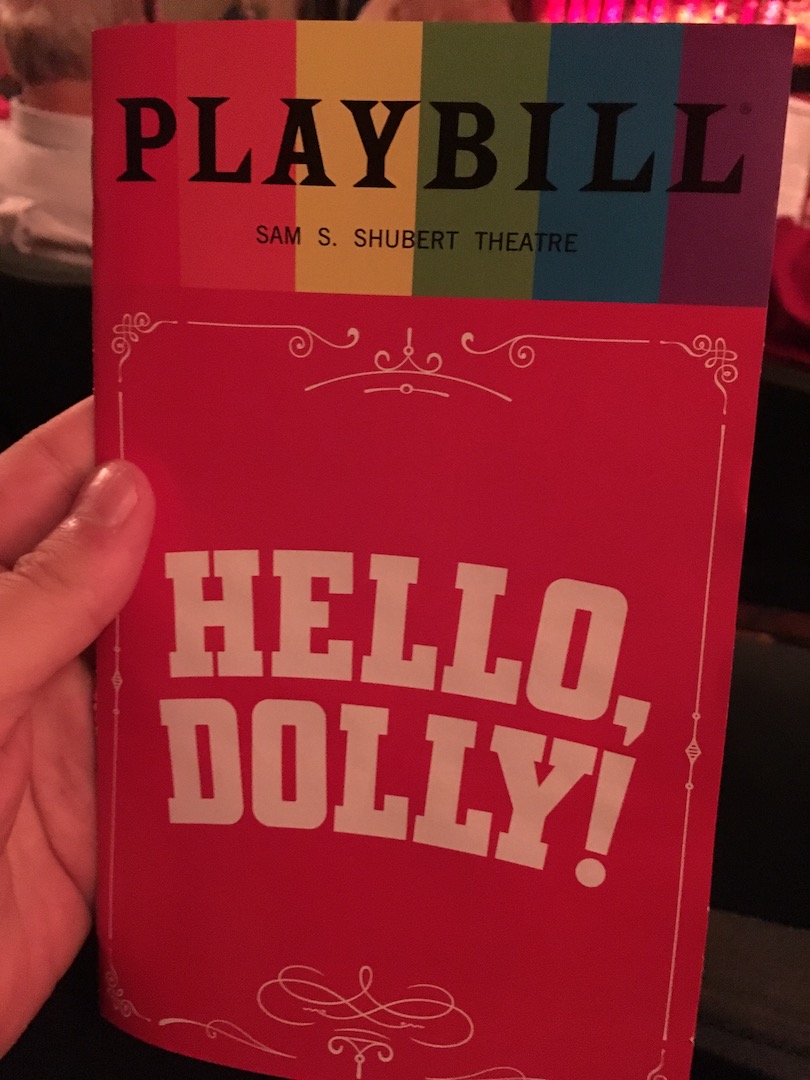
So I wasn't excited when a friend offered me in a block of tickets to see (it better be) Bette Midler in Hello, Dolly! at the Shubert Theatre. The few touring shows I'd managed to take in around 2000 in Milwaukee (Cabaret, Sunset Boulevard with Petula Clark, and, was it?, The King and I) left me underwhelmed at best. And I despised the grotesquely distended 1969 film version of Hello, Dolly! featuring a ridiculously miscast/shoehorned-in Barbra Streisand. But I'd never been to a Broadway show. And I adored Midler's early 1970s pomo rewiring of popular music history even though she quickly abandoned this project for the schlocky half-measures and compromises of El Lay. So I went in expecting to get all haughty about a moribund art form and two and a half hours later left with tears in my eyes.

First, the bad. $152 for one ticket. Go around the corner to the AMC Empire 25 on 42nd St. and you can pay about $18 to see a first-run movie. Still a despicable price but you can see eight movies for one Dolly. Or better yet, trek down to my favorite movie theatre in New York City, Anthology Film Archives, and purchase a general admission ticket for $11 and see some of the greatest films ever made. As much as I loved my time at Dolly, it cannot match the out-of-body experience I had watching Mosaik Im Vertrauen (Peter Kubelka, 1955) at Anthology in September last year.

Also, the seats. We were in the last row of the mezzanine (my seat was K 23) and had a remarkably unobstructed view for such a thin field of vision. But we missed some action on the upper floor of Vandergelder's Hay and Feed Store and, worse, Dolly's entrance at the Harmonia Gardens Restaurant. And the standing ovation completely obstructed the curtain call. But I followed the Broadway veteran (of several shows just that week!) in K 25 down the aisle to at least Row F to get a better view.

Overall, though, I remain stunned by how moved I was. It had little to do with Midler. I teared up when she asked her dead husband Ephraim to give her a sign that it was okay to marry Vandergelder. But the moments that really choked me up were, well,  good old fashioned communist ones -  ensemble numbers like "Before the Parade Passes By," "Hello, Dolly!," the finale, all amplified by Warren Carlyle's choreography, built on Gower Champion's original work, no less astonishing in the serpentine movements throughout the Hay and Feed Store during "It Takes A Woman" than in "The Waiters' Gallop." If we cry at melodramas because of the impossibility of communication, we do so at musicals for the opposite reason - that disparate people can come together like rama lama lama. And Midler's star wattage is crucial for this effect. Donna Murphy, whom I never even heard of until this weekend (chill, theatre queens), will no doubt sing the role better on Tuesdays as Midler herself would probably concede. But the ensemble effect of the musical subsumes even a supernova like Midler and for an overwhelming moment, we are all one.

It's a fleeting moment for sure, especially with $59 for the cheapest ticket. I certainly don't want to make common cause with the audience if they agree with Ben Brantley's contention in a depressing New York Times review that there was "a more innocent age of American history" or that camp doesn't exude "bone-deep affection and respect." And I definitely want to avoid the two psycho fans I encountered afterward whom I tried to convince that Midler had left the building and was whisked away in a car the nanosecond she left the stage. But the show taught me what it might feel like to make common cause with them and I am privileged to have witnessed it.

Labels: , ,

Monday, May 30, 2016

The Cohens and Kellys in Hollywood (John Francis Dillon, 1932)

The only reason I saw this flick in MOMA's Universal Pictures: Restorations and Rediscoveries, 1928–1937 series is this description from the site: "This one throws in a satire of the movie business, as young Kitty Kelly (June Clyde) becomes a star at Continental Productions, and young Melville Cohen (Norman Foster) writes songs for musicals. Crisis arrives when audiences grow tired of all singing, all dancing—an experience Junior Laemmle knew firsthand." Well, that doesn't happen until well into the 75-minute running time. Dillon (who?) never shows young Cohen working on a musical. But you do receive an acknowledgment that theme songs were crusty by 1932. And apart from a scene in which Boris Karloff, Lew Ayres, Tom Mix, Gloria Stuart, etc. are hobnobbing at the Coconut Grove (I think...I was getting sleepy by that point), that's all worth noting about this wincingly unfunny ethnic comedy. Most painful was an interminable scene in which a Russian director rants while perfecting his art on the set. Ugh.

Labels: , ,

Saturday, April 16, 2016

Twilight Saloon (Tomu Uchida, 1955)

If you're one of the thousands (millions?) who have fallen in love with Terence Davies' Distant Voices, Still Lives, then you ought to check out Twilight Saloon. Confined to a saloon from open to close one evening, the narrative follows the lives of various patrons and employees and some viewers will no doubt disdain the telegraphed stories and hastily wrapped up conclusions. But the real drama here is musical. Twilight Saloon is choked with songs - folk songs, pop songs, military songs, workers' protest songs, arias. Stephen Foster's "Beautiful Dreamer" and "Jeanie with the Light Brown Hair," a record of Josef Marais' (I think) take on "Brandy, Leave Me Alone" (and allusion to the "Whiskey, Laisse-moi Tranquille" scene in Hawks' The Big Sky?), a story-turning "Toreador Song," Japanese music about which I'm ignorant, etc. It's about what we do with songs, how they insinuate themselves into our lives, how they police the distinction between professional and amateur, how they signal disappointment, hope, rage, lust, justice, resignation. I absolutely adored it and kudos once again to Michael Raine for programming it at Japan Society's Japan Sings! series.

Labels: ,

Saturday, April 09, 2016

You Can Succeed, Too (Eizô Sugawa , 1964)

It's going to be difficult to top the opening night film at Japan Sings! The Japanese Musical Film at Japan Society. You Can Succeed, Too (Kimi mo shusse ga dekiru) is an absolute stunner, calling to mind Yasuzo Masumura's Giants and Toys, Frank Tashlin's Will Success Spoil Rock Hunter?, and Frank Loesser's How to Succeed in Business Without Really Trying and easily the equal of any of them. Concerning a tourist agancy's attempts to become more efficient like (their perception of) America, the film is most memorable for how it reprises several of its big musical numbers in more ironic contexts at later points in the narrative, especially the showstopping "In America" number available in a horrible Youtube clip below without subtitles (indeed, the print last night was shown with live subtitles). 

I cornered the curator, Michael Raine, Assistant Professor of Film Studies at Western University, Canada, after the film and he told me that the final number which takes place on a construction site was actually an American military base. But the filmmakers could get only a few shots since they were kicked off the site! So the scene quickly switches to hilariously fake studio sets. Raine suggests that these material conditions reflect the film's main theme - the need to, but ultimate impossibility of, emulating America. And it definitely serves as the film's hysterical moment, as per Geoffrey Nowell-Smith's "Minnelli and Melodrama," when realist representation breaks down to signal the film's inability to contain its own contradictions. Raine also told me he showed it to Miriam Hansen who loved it! You will too!!

Labels: ,

Wednesday, October 01, 2014

Best Foot Forward (Eddie Buzzell, 1943)

Military academy movies are homoerotic enough. Fuse one with the musical's propensity for turning bodies into decorative elements and you have a Vesuvius of male objectification. In MGM's Best Foot Forward, Lucille Ball, playing herself, winds up at a military academy teeming with horny boys. But well before they literally tear her clothes off in one scene, the young men of fictional Winsocki find their own bodies subjected to hazing and awkward ornamental choreography.
My favorite scene has a row of cadets singing one line each of "Wish I May Wish I Might" into one another's eyes:
Wish I had an old jalop job

Just a little olden top job

Wish I had myself a C card

That would suit me to a T, pard

I could take my drag a-drivin'/And I would get the wish I wish tonight

And the cadets are always touching each other in that guileless, pre-Stonewall way.
So much so that the über-catchy "Three Men on a Date" doubles as a song about three men on a date with each other.
Other selling points:
Rubber-faced Kenny Bowers (on the left in the pic above) still playing to the nosebleed seats
A frothy score by Hugh Martin and Ralph Blane
Nancy Walker butching things up in a spirited but arch performance
Several hot numbers from Harry James and His Music Makers

Labels: ,

Monday, September 29, 2014

Footlight Serenade (Gregory Ratoff, 1942)

More than any other classical Hollywood genre, the musical affords directors the opportunity for displaying the male body and nowhere is that more apparent than in the "I'm Still Crazy For You" number from Footlight Serenade (Gregory Ratoff, 1942).
That's John Payne getting a rubdown and then some from Betty Grable. It may have been part of his star text to display his beauty so nakedly. Just check out the photo with which IMDb saw fit to represent him. Nevertheless, "I'm Still Crazy For You" indulges in a role reversal typical of the musical with a de-cheesecaked Grable the aggressor wrestling Payne's near-nude flailing body.


And it ends on an even itchier note as the couple face away from the camera for the last line of the song and a bit of dialogue thereafter, sweat glistening off of Payne's back. Head-scratching but delightfully queer.
Other selling points include a typically excellent performance by Victor Mature as an unstable love interest. The Medveds were high when they nominated him for The Worst Actor of All Time in The Golden Turkey Awards (Richard Burton won). He was one of the greats, outclassing everyone in this film and capable of using his agitation with the profession to lend his characters a slight psychotic edge. And keep an ear cocked for "Except with You," a Ralph Rainger and Leo Robin nugget begging for a country remake.

Labels: