Thursday, December 12, 2024

The Assassination of Trotsky (Joseph Losey, 1972)

This film appeared in the Medveds' 1978 book The Fifty Worst Films of All Time. Like many of the titles included therein, The Assassination of Trotsky isn't quite deserving. But it's a head scratcher for sure. The main problem is that there seems not to have been a script or perhaps it arrived on location in tatters. A screenwriter is listed (Nicholas Mosley, who later wrote a critical biography of his father, British Union of Fascists founder Sir Oswald Mosley). But much of the screenplay consists of Trotsky (a paycheck-mopping Richard Burton) dictating his memoirs which does little to push the narrative (or even any ideological project) forward. Slow, lazy pans document the exile's Mexico City compound lending the production a travelogue feel. Alain Delon is on board as Trotsky's assassin Frank Jacson, canoodling with Romy Schneider and reciting risible dialogue that one hopes was improvised or written moments before shooting. Losey et al. convey so little sense of Trotsky as a Great Man that one could claim the film instantiates a Communist aesthetic. But The Assassination of Trotsky is more a Swiss cheese wheel than a film, car-crash fascinating but not exactly a pleasurable or recommendable experience.

Grade: B-minus

Labels: ,

Thursday, August 08, 2024

Twisters (Lee Isaac Chung, 2024)

Not much to say about this one except to note that it's predictably and ominously okay, corporate, quirk-free, and threatening to derail the career of the promising Chung who helmed Minari, the best film to be nominated for the Best Picture Oscar in 2020. Three brief observations:

1. The film is in a long Hollywood tradition of crapping on traditional avenues of expertise, perfect for the internet era when scores of malcontents are "just doing their own research." Daisy Edgar-Jones' character represents the status quo of education while Glen Powell's crew are Salt of the Earth nomads who are supposedly free of institutional constraints and a profit motive (how do they eat, though?). They look so crunchy that they could slip imperceptibly into Furiosa: A Mad Max Saga

2. I was in chronic pain and on a variety of drugs while watching and I honestly thought there was at least another half an hour (or more!) at the end of the film. I assumed Jones' would go talk to The Weather Council or whatever in New York, they would dismiss her findings, and then she'd rejoin the Powell crew for more tornado thrills. I'd wager that that's a mark in the film's favor (or I was on some primo pain killers). 

3. Don't let Powell blind you to David Corenswet's hotness.

Grade: C+ (downgraded a notch so I'm not tempted to revisit)

Labels: , ,

Tuesday, April 23, 2024

Night of the Comet (Thom Eberhardt, 1984)

The obvious problem with this teens-navigating-the-apocalypse turkey is that Eberhardt didn't have enough script for a 95-minute movie, even though he wrote the thing himself. So when Reggie (Catherine Mary Stewart, Bibi in my beloved The Apple) drives through an empty metropolis after a comet has vaporized most of humanity, we're treated to a painfully slow shot-reverse shot sequence of Reggie looking at deserted buildings - first Reggie, then a deserted building, Reggie, building, Reggie, building, on and on, argh!, until a long shot (and looooong take) catches her driving off into the distance. Instead of conveying crucial narrative information, the sequence says, "whew - that ate up two minutes." The remainder proceeds in this lumpy fashion with a criminally anonymous soundtrack which goes for even more criminally exorbitant sums on Discogs. Mary Waronov and Geoffrey Lewis show up as was de rigueur in the 1980s playing maybe sympathetic, maybe not scientists, I forget which even though I watched this three days ago. Pure video-store fodder, Night of the Comet exists solely for Bad Movie Nights, allowing for plenty of space to talk over it and throw popcorn at the screen.

Grade: D


Labels: , ,

Raise the Titanic (Jerry Jameson, 1980)

I saw this a month ago and have already forgotten most of it. Helmed by the auteur responsible for Airport '77, the worst of the Airports, it's a drearily competent dinosaur with Jason Robards and Alec Guinness on board to pick up what I hope was a hefty check. The only thing I want to remember is the fact that once the Titanic is raised, the raisers felt it necessary to set up a complete coffee station inside. Check out the background in the pic below.

Grade: C


Labels: , ,

Sunday, December 31, 2023

Saltburn (Emerald Fennell, 2023)

SPOILERS (but gawd, who could possibly care?)

Let's get the paltry good out of the way first. I admired Fennell's Promising Young Woman from 2020 so I had mild hope for Saltburn. Indeed, many of the performances were top-notch (if you care about such things). A few of the vicious one-liners were funny although I never laughed out loud once and wonder about the performative nature of the laughter to which lovers of this film have confessed. The score was intermittently arresting. And the final scene, solely for the long-take display of Barry Keoghan's naked body, promises love-cannon fodder for ages. Beyond that, Saltburn is one of the least promising films of 2023. 

Boosters cite De Palma and giallo in hyping Saltburn, a good shorthand for what I hated about it given that I'm blind to the dubious charms of Carrie and Suspiria. This means we're in Style Over Substance territory here and we're not supposed to question character motivations or address glaring plot holes. But as with De Palma and Argento, Fennell’s sense of style is too half-assed to compensate. A red dining room here, a bacchanalian party there, and plenty of beautiful flesh in between are not enough to paper over the thin story. Why bother with story at all? Why not empty your characters of humanity and transform them into goal-disoriented nodes of pleasure as Cronenberg did in Crash? Why not amp the style beyond the teleological as in, oh, The Color of Pomegranates?

To the extent that Saltburn is a horror film, I hate it too. As with Jason and Michael and Freddie after the first films in the franchises, what does Oliver Quick (Keoghan) want? Fennell gives us so little backstory to chew on that Oliver remains a pug-beautiful cipher. He’s a middle-class lad who wants the good life. So he kills an entire damn wealthy family and dances naked in the palatial estate he has dastardly inherited from them and…that’s the end point of this goal-oriented story? This is what he was truly working towards with reportedly clever flashbacks to show how he pulled off all this mayhem? He seems happy gyrating to the eye-rollingly corny “Murder on the Dance Floor.” But it’s difficult to know for sure that his desire has been satiated given the character’s cardboard construction. What is he going to do tomorrow? Even as a critique of capitalism’s tendency to create arrivistes seething with envy, it’s toothless, weak-minded satire. And I’m not supposed to care about or even mention American cousin Farleigh’s (Archie Madekwe) reaction to his extended family being slaughtered so I’ll bow out here.

Grade: D


Labels: ,

Wednesday, November 22, 2023

The Killer (David Fincher, 2023)

The Killer (David Fincher, 2023)

The problem with this one is easy, especially if you recall the fiasco of Deckard's narration in the original version of Blade Runner (Ridley Scott, 1982). You'd think filmmakers would have long since learned that unnecessary voice-overs can not only induce derisive laughter but deflate the narrative tension as well. One must assume Fincher as well as screenwriter Andrew Kevin Walker (adapting the graphic novel by Alexis "Matz" Nolent and Luc Jacamon) had more freedom than Scott did forty years ago so the blame for the risible narration intoned by the titular assassin (Michal Fassbender) falls on them. For the first third of the film, the nameless Killer spends almost all of his time alone waiting for the moment to assassinate a high-profile target. But instead of maintaining an air of menace or existential dread from the visuals and sound design, the Killer's preposterous voice-over thoughts about his profession take a sonic front and center. I swear I'm not trying to be cute when I claim that this narration has the pseudoprofundity of Bela Lugosi's in Glen or Glenda? (Edward D. Wood, Jr., 1953) for competition. This is doubly irritating since Fincher punctuates the sequence with a brief meeting between the Killer and the client paying for the assassination. That's more than sufficient narrative explanation to ground a voice-overless exposition. Instead, Fincher brings us right back to the Killer's rub-a-dub-dub-three-men-in-a-tub philosophizing. 

After that, the damage is done even though the narration calms down. But that gives way to a tired revenge fantasy in which yet another actress (Sophie Charlotte) serves as mere foil with barely any screen time. The cameos are fun, particularly Tilda Swinton in Ice Queen mode (does she have any other mode lately?). But the sole reason to watch, or rather, listen is the music. Trent Reznor and Atticus Ross' score alternates between inorganic electronica and non-musical sounds such that any notion of the natural becomes irretrievable. And, for some reason, the Killer listens only to the Smiths as he jet-sets between assassinations and revenge plots. Instead of benefiting the narrative in any discernible way, the indifferent locations blow back into the music and wind up deepening Morrissey's self-absorbed warbling. The world truly doesn't care about him and "Heaven Knows I'm Miserable Now," say, takes on an unexpected pathos as a result.

Grade: B-minus (upped a notch for the music but then down again for the Killer's ridiculous pseudonyms - Archie Bunker? Why not Mickey Mouse?)

Labels: , , , ,

Wednesday, September 27, 2023

Bottoms (Emma Seligman, 2023)

SPOILERS (although the film is so baffling I'm not sure what exactly I'm spoiling)

For the record, I adore Eighth Grade (Bo Burnham, 2018), Booksmart (Olivia Wilde, 2019), and Barb and Star Go to Vista Del Mar (Josh Greenbaum, 2021) and I think The Ladies Man (Jerry Lewis, 1961) is one of the greatest films ever made. So comedy (or even satire per se) has never been my problem, hence why I feel comfortable deeming Bottoms a disaster of tone and comedic structure, the biggest disappointment of the year. 

The story concerns PJ (Rachel Sennot, who co-wrote the screenplay with Seligman) and Josie (Ayo Edebiri, terrific), two lesbians at Rockbridge Falls High School trying to get laid before graduation. Both are infatuated with cheerleaders Isabel (Havana Rose Liu) and Brittany (Kaia Gerber) even though both are apparently straight. At the local fair, Isabel has a fight with her boyfriend, hunky quarterback Jeff (Nicholas Galitzine), and she hops in Josie's car to escape him. Jeff refuses to move from the front of the vehicle and Josie drives forward, lightly tapping Jeff's knee. But Jeff reacts as if he's been rammed at full speed. It looks as if he's about to lose consciousness as his team runs to his aid and Josie drives off with PJ and Isabel. 

OK a little odd. But here, not even ten minutes into the film, is where the film starts to lose its grip on comedy. In school the following day, Jeff is on crutches and the entire school (even the queer kids for some reason) is mad at Josie and PJ for "maiming" Jeff. But after class, Jeff, out of focus in the background, walks perfectly well with his crutches in his hands. Two scenes later in a long shot, he comes out to the football field on crutches and then casts them aside, presumably cured.

Questions: Wiki (which I had to turn to for basic narrative assistance) says he was "feigning severe injury." Why? What is Jeff's motivation? The "injury" serves the narrative purpose of causing PJ and Josie to get in trouble. The principal calls the duo into his office and castigates them for maiming the star quarterback. They convince him that they were merely practicing for a female empowerment fight club which gives them the idea to make the club a reality in the hopes of getting closer to Isabel and Brittany, a ploy which takes up much of the remaining film. But what purpose does it serve Jeff to have feigned severe injury? Most importantly, why is this funny? And why is Seligman relegating her putative jokes to long shots and out-of-focus backgrounds? It bespeaks a lack of confidence in the comedy rather than any absurdist quirks.

Even more confusing (and equally unfunny) is the climactic football game. Josie learns that Huntington, the rival team, is planning to murder [sic] Jeff by spraying the field with pineapple to which Jeff is allergic. Josie and the club members cover the sprinklers. But Huntington starts to attack the girls. An all-out fight breaks out. But for no discernible reason, the Rockbridge players fall back leaving the girls to battle on their own. Presumably (an adverb which should have no purchase in a mainstream narrative film), the girls are no longer covering the sprinklers and, in a long shot (yet again), the team seems to be caught in a mist of pineapple juice. 

 
Because this is a long shot, it is difficult to tell if the sprinklers have indeed been uncovered. Josie has carried Jeff off the field. But in this shot, we see a player pass out. Is the entire team now allergic to pineapple too? The other players seem to be recoiling in terror. Are they suddenly scared of Huntington even though the teams were taunting each other a few moments prior? And presuming any of this is funny, why is it in a long shot where the details and chain of cause and effect are difficult to make out? The only indication that the sprinklers may be engaged is an occasional mist on the field. But then, after the girls have laid out the entire Huntington team, the sprinklers turn (back?) on. 
Some will chalk up these inconsistencies to absurdist humor. But there are more effective and sure-footed ways to situate absurdity in comedy. Lewis' The Ladies Man doesn't even tell a story and manages to exploit the film medium more totally than any film extant. The funniest moment in Barb and Star occurs at the climax when the titular duo needs a jet ski to throw a mosquito-attracting homing beacon into the ocean. The owner of the jet ski absurdly tells them they can borrow it because he needs no further information. This one line makes hay of cause and effect but still allows the story to continue. And it's not hiding in the background like some wallflower of a joke. The humor (such that is) in Bottoms is just sloppy and uncertain.

Worst of all, Bottoms traffics in a conventionality that undercuts its celebrated queerness. There are tortured narrative reasons why the film centers on football even though sports are the source of so much queer pain. But however much logic (or humor) those reasons lend the story, they nevertheless compromise the film's queerness. When Josie goes to visit Rhodes (Punkie Johnson), a lesbian elder, for advice, the scene posits queerness as a melancholy lot in life, a stereotypical, if not homophobic, narrative structure.* Rhodes confesses that she never had many friends in high school and as she's "gotten older in this world, it's just gotten more sad." Why precisely she's sadder now is left unexamined. And while we know little about Rhodes' queer present, Rhodes somehow knows a great deal about football. She informs Josie about the longstanding rivalry between Rockbridge and Huntington and that impels Josie to convince PJ to save Rockbridge in the film's climax. But why, in a film that supposedly performs a queer spin on the high-school comedy, does the writer/director privilege knowledge of football history over even the briefest exploration of a lesbian present, and an elder lesbian present at that? For what it's worth, in over two decades of schooling, I never once attended a football game and thus knew nothing about any rivalries, no matter how longstanding or murderous. I do recall, vividly, being made to feel improperly socialized for failing to take up a traditional masculine role in playing sports and caring about them.

When Josie explains to PJ why they should save the football team, it does indeed make narrative sense. The entire school has learned about Josie and PJ's ploy for using the club as a way to get laid. Josie reminds PJ of this betrayal and convinces her that saving Rockbridge would be a good way to win back their trust and show off what they learned in the club. But it makes no thematic, much less emotional, sense. When PJ retorts, "Sorry, you're saying you want me and then you and then all the girls that fuckin' hate us to get together and save some fuckin' football player, who we hate? Circle of bad vibes," that's precisely the response I had. And Josie's narratively coherent explanation fails to negate that, the circle of bad vibes and past humiliations in gym class washing over the remainder of the film.

Grade: C

*For more on this aspect of queer representation, see Richard Dyer, "Coming Out as Going In: The Image of the Homosexual as a Sad Young Man" in The Culture of Queers (London and New York: Routledge, 2002), 116-136.

Labels: ,

Wednesday, August 16, 2023

Howard the Duck (Willard Huyck, 1986)

I had high hopes for this. I'm a huge fan of Messiah of Evil, the 1973 horror film Willard Huyck co-wrote and directed with his wife Gloria Katz. My favorite genre is the film maudit. And, in general, I exhibit deep affection for broken, unloved films such as, to choose one example utterly at random, Some Call It Loving. But sometimes bad movies are just bad and Howard the Duck falls dead from the sky.

If that last phrase made you wince, then you now have a taste of how every single comedic line in the film, without fail, earns my all-time favorite adjective - arch, "marked by a deliberate and often forced playfulness, irony, or impudence." After one of the many travails he has to endure after crashing on Earth, Howard wisecracks nudge-nudge one-liners like or "Talk about bad breath" or "I need this like I need another tail." Did anyone on the planet ever laugh at such sub-Groucho Marxisms, "jokes" that would've tanked in the Borscht Belt of the 1950s? The only laughter I experienced was an occasional seconds-delayed guffaw over how such godawful writing made it to the screen.

Even worse, the imperative of having to adapt a Marvel comic book for a major studio drained the film of all the quirk and personality so evident in Messiah of Evil. Film maudit fans might appreciate John Barry's incongruous score (ILX user Old Lunch describes the music, in a line funnier than any of the film, as akin to "watching some heartwarming '80s family movie about two lovable scamps learning the true meaning of Arbor Day") and the inconsistent reactions to a talking duck in Cleveland. But with those potential quirks out of the way by the first quarter, Huyck and co-writer Katz proceed with a crushing anonymity through overlong chase and destruction scenes. 

So it's bad but exactly how bad? The failure is too fascinating to merit an F and it didn't enrage me like Unsane. The title song, written by Thomas Dolby and George Clinton and sung by Lea Thompson (a terrible performance but an understandable one given what she had to work with), is catchy albeit baffling: "We call him Howard the Duck/Ain't no way to conceal it...If it ain't funk, you don't feel it." Jeffrey Jones deserved the biggest check for the "Dark Overlord of the Universe" makeup he had to endure. Tim Robbins is tall and strong. And the best performance is a cameo by Jorli McLain as the waitress Crystal. Her brief moment is so raw and natural that she could've stepped off of Kelly Reichardt's Certain Women. And she utters the one remotely witty line in the entire film: "You know, hostility is, like, a psychic boomerang." McLain has only two more credits to her name but went on to invent, with her former partner Wendy Robbins, the Tingler head massager. Sadly, she died in 2010 at 49.

In short, SpaceCamp, another 1986 entry starring Lea Thompson, now feels like Citizen Kane

Grade: D


Labels: ,

Wednesday, July 26, 2023

1917 (Sam Mendes, 2019)

What about this particular story or historical event dictated that it be filmed in "one take"? The gimmick turns Saving Private Ryan (Steven Spielberg, 1998) into a video game and, as such, I found it insufferably goal-oriented. There's a vaguely psychedelic moment in the middle where the hot-thank-gawd protagonist played by George MacKay holes up in a village on fire. It looked like a sound stage and I was fond of this brief bit of artifice in a film praised for its realism. But if Mendes has any insight into what makes WWI a unique disaster, then he's hidden it quite well under his dexterous camera movements. A dreary slog.

Grade: C+ 


Labels: , , ,

The Lego Batman Movie (Chris McKay, 2017)

Inbred and lacking even the first one's (groans) chickenhearted critique of Big Business, this hebephrenic followup is pure teaching moment for a media studies professor. It blends content and commercials almost as shamelessly as a Hallmark Christmas movie. Damn near every image and sound is a property of Warner Bros. (a division of Time Warner) such that the movie is nothing but a marketing hall of mirrors (quite literally at one point in yet another dreary ripoff of The Lady From Shanghai). And when Gotham is cleaved in two at the climax, the Lego characters bridge the two sections together by locking into one another to remind us how Legos work (and to get the toddlers up to speed). Were I not repulsed by untrammeled media conglomeration, I'd call it genius. But I might still have to append an "evil" to it. 

Oh and apparently it has some lessons to teach about the importance of family or not going it alone or whatever. But don't forget to ask your parents for some more Legos, kids.

Grade: C 

Labels: ,

Wednesday, March 08, 2023

2022 Best Picture Oscar Nominations Ranked

The Fabelmans (Steven Spielberg) - Astonishing. For the first time in his career, Spielberg traffics in an ambiguity that keeps this semi-autobiographical legacy film unpredictable. The scene in which the beach-blond jock confronts Spielberg stand-in Sammy (Gabriel LaBelle) may be the director's best ever for the baffled and contradictory responses it's elicited. And just when you think the dénouement is going to lock into Horatio Algeresque step, Sammy walks up to his new Hollywood apartment not in triumph but in the midst of a full-blown panic attack. Not counting A.I.: Artificial Intelligence, the man's best film since Minority Report if not 1979's underrated 1941. A

Tár (Todd Field) - A film designed to be debated into perpetuity. Like a good poststructuralist, Field destabilizes the center of each scene (including the exquisite ending) and maintains an edifice of free play throughout. I haven't discussed a film so much in years, especially with people who aren't avid filmgoers. A

Elvis (Baz Luhrmann) - Reviewed here. A-minus

Women Talking (Sarah Polley) - A film designed to plunge Armond White types into apoplexy. I admired the severe visual palette and compressed intensity of this "act of female imagination." A-minus

Triangle of Sadness (Ruben Östlund) - Vertically, yet another facile skewering of the rich and heartless. Horizontally, it shifts gears so many times that it gives whiplash to the viewer and, one must assume, Östlund himself given how he finishes it all off with a hilariously perverse non-ending. A-minus

All Quiet on the Western Front (Edward Berger) - Not sure what to do with this remake of the 1930 Best Picture Oscar winner. It's effectively anti-war, sure. But why was it remade now? B+

Everything Everywhere All at Once (Daniels, 2022) - They spent so much time on this multiverse concept that they forgot to tell a compelling, non-cookie-cutter story. Once the rules of the multiverse were laid out, you could see how the rest of the film was going to lock into its narrative beats with dreary predictability. B

The Banshees of Inisherin (Martin McDonagh) - Reviewed here. B

Avatar: The Way of Water (James Cameron) - I rolled my eyes about two dozen times at this "three-hour land acknowledgment" (to borrow Tyler Austin Harper's words in Slate). But I have to begrudgingly concede that Cameron brings off his colossally dorky vision with brio and keeps all 192 of those minutes moving briskly. B

Top Gun: Maverick (Joseph Kosinski) - Marginally more digestible than the godawful original. But it's essentially a remake so yeah, no. My Xmas 2022 screening of it is mercifully fading from memory to make for contemplation of much more substantial films such as Myra Breckinridge, Reform School Girls, Massacre at Central High, The Ritz, The Cassandra Crossing, etc. (to choose some recently digested titles). D+


Labels: , , , ,

Monday, January 23, 2023

The Sting (George Roy Hill, 1973)

SPOILERS but who could possibly care?

I've written about the tendency of 1970s Hollywood filmmakers to inflate their genre pics into white elephant art. But I didn't anticipate I'd be throwing The Sting, a film I hadn't seen in probably 40 years, onto the pile. What a slog! It starts out as a promising example of the gambling film, a favorite genre probably because gambling has always seemed so butch and beyond me. All the proper nouns, especially names like Horse Face Lee and Suitcase Murphy, and card terms (slice it to the side, horizontal ponies*) announce themselves as standards of traditional masculinity that I will never attain. It's a turn on, in a way. But lawd, why did this thing have to be 129 minutes? The pace slows in the last third to accommodate, you guessed it, compulsory heterosexuality, a waste of time in a film that couldn't care less about women. The entire Loretta (Dimitra Arliss) subplot could be excised. Hooker (Robert Redford) pining for her serves only to postpone the sting to the last ten minutes of the film. And could the sting be any lamer? The earlier card game on the train is far more intense. We know Hooker and Gondorff (Paul Newman, with inhuman eyes) can't die. So when we see them get shot, the "sting" is blunted. This was the best picture of the year according to Oscar? Come back, The Exorcist, all is forgiven.

Grade: C+

*I made those up. 

Labels: , , ,

Monday, December 19, 2022

Krampus (Michael Dougherty, 2015)

Due to a fascination with the Krampus myth (we need something harsher than mere coal in your stocking to scare American children into being good), I had high hopes for this film. But the beast doesn't even show its face until 77 minutes into a 97-minute movie. Before then, the monsters are various evil snowmen, animated killer toys, and some goblin types (I think - many cat naps were had). Why director/co-writer Michael Dougherty had Sid's toys from Toy Story take center stage instead of, um, Krampus remains a mystery. How he roped some fairly substantial names such as Adam Scott, Toni Collette, and Conchata Farrell into a excruciatingly dull, painfully unfunny bad-family horror-comedy remains a mystery as well. As I always say about such botches, I hope the catering was good. And the best I can say for this particular botch is that unless someone can convince me that any of the Krampus sequels or offshoots are at Jeanne Dielman x Aftersun levels of greatness, I will be saving many precious minutes avoiding them all.

Grade: D

Labels: , ,

Friday, December 16, 2022

The Banshees of Inisherin (Martin McDonagh, 2022)

One doesn't want to be ungrateful since The Banshees of Inisherin is quantum leaps better than Martin McDonagh's previous outing, the juvenile, execrable Three Billboards Outside Ebbing, Missouri (2017). Still, it suffers the fate of so much Oscar bait before it - all its roads lead to a Message. It starts off as a promising Mikey and Nicky (Elaine May, 1976) variation. During the Irish Civil War in 1923 on the fictional isle of Inisherin, two long-time friends have a sudden falling out. Colm (Brendan Gleeson) wants nothing more to do with Pádraic (Colin Farrell). When Pádraic presses for a reason why, Colm tells him that he's boring. Furthermore, any attempts at rekindling the friendship will result in Colm cutting off one finger per attempt. Since Pádraic keeps pressing the matter, Colm starts to lose fingers, each bloody stump thrown against Pádraic's door to prove Colm means business. Unable to move on from Colm's toxic behavior, Pádraic devises his own violent retribution.

Gleeson and Farrell inhabit their characters with a depth worthy of an Oscar which I predict Farell will win. Not only do we feel Pádraic's pain at being ghosted but we grasp Colm's longing for a more meaningful existence than that available mindlessly chatting with Pádraic at the pub every night. Colm is older so he's feeling his last act approach which provides further justification for his coldness, devastating and just plain mean though it is. 

As the war rages on in the background, though, it's clear McDonagh meant the absurdity of the central conflict as an allegory for the Irish Civil War. Instead of recognizing Pádraic as his brother, Colm cuts off his nose to spite his face (or fingers to spite his hand). But that's about as deep as McDonagh takes it. A colleague suggested that to pin the traditionally female designation of banshee on Colm and Pádraic upholds Siobhán (Kerry Condon), Pádraic's sister, as a voice of reason and marks the moment when she leaves in disgust as the point at which the film descends into irreversible tragedy. But all of this is implied in the phrase "Civil War." It remains unclear what exactly McDonagh is trying to say about the event. I knew nothing about the Irish Civil War going in and I know a teensy bit more now. And as always with these kind of eat-your-veggies projects (like, oh, Spotlight), I'd much rather read the Wiki about it, especially given dutiful, by-the-numbers direction which stymies any desire for further exploration.

Grade: B


Labels: , , , ,

Thursday, December 15, 2022

Bones and All (Luca Guadagnino, 2022)

One aspect of sci-fi and fantasy and even horror that I cannot stand is the necessity, if not overabundance, of explanation - world building or origin stories or plumbed childhoods designed to justify why the supernatural/mayhem is happening, a dreary, utilitarian waste of time in my experience. It's why the musical is my favorite Hollywood genre; spontaneous outbursts of song are just that - singing out with no justification or even a source for the music (except when there is, e.g., Enchanted, the "Once More With Feeling" episode of Buffy the Vampire Slayer, etc.). So it stuns me to report that Bones and All desperately needs some justification. 

It's the 1980s in flyover America and Maren (Taylor Russell) is experiencing some of the most palpable teenage angst imaginable. She is a cannibal and has such difficulty controlling her impulses that her father (André Holland) abandons her. Thus begins a de facto road movie as Maren tries to figure out her affliction. She meets several other cannibals, the sexiest among them being Lee (Timothée Chalamet). Of course, a romance blossoms. But will they be able to keep each other's impulses in check?

Guadagnino has a superb eye for the bombed-out locales of Mid-South America (or what my pal Jeremy Posadas would call Appohzarka and the Heartland and mid-Atlantic South). But since the contours of the cannibalism are sloppily explained, we are never sure what exactly is at stake for the principals or what their plight has to do with the abandoned hamlets in which they take up residency. The final act implies that Maren and Lee can, indeed, keep their cannibalism in check and they are on their way to the straight and narrow before an even more sloppily conceived dénouement changes their plans forever. But while Guadagnino and screenwriter David Kajganich (basing his script on Camille DeAngelis's novel) leave too much of the story to implication, they bask in gore with a sensationalist specificity. The thrill of showing fresh-faced youth chewing on human flesh quite overwhelmed any sense of narrative drive or even purpose. Let the Right One In (Tomas Alfredson, 2008) managed to situate its gore within a specific socioeconomic context. But if Guadagnino and Kajganich were after some sort of allegory about how capitalism in its death throes forces American to feat on one another, then the connection just does not come through. Why the 1980s exactly? Why Maryland then Kentucky then Michigan? 

Grade: B-minus (and dropping)


Labels: ,

Thursday, September 29, 2022

C.H.U.D. (Douglas Cheek, 1984)

You know you're in trouble when the director doesn't have a Wikipedia page and, upon further inspection, has only one feature film to his credit. You know you're in deeper trouble when your boyfriend proclaims while watching, "that's a cool shower head." Given the widespread references to chuds in popular culture (my favorite is from Marge to Homer in the great NYC episode of The Simpsons: "Of course you'll have a bad impression of New York if you only focus on the Pimps and C.H.U.D.s."), I assumed C.H.U.D. (Douglas Cheek, 1984) would prove gently creditable. But the title is far more memorable than the film itself. It's all too competent with a excruciatingly dull first act that fails to prep you for the lame cannibalistic humanoid underground dwellers. Cool new wavey score from OMD refugees Martin Cooper and David A. Hughes, though.

Grade: D+ (the plus is for that cool shower head)

Labels: , ,

Friday, August 13, 2021

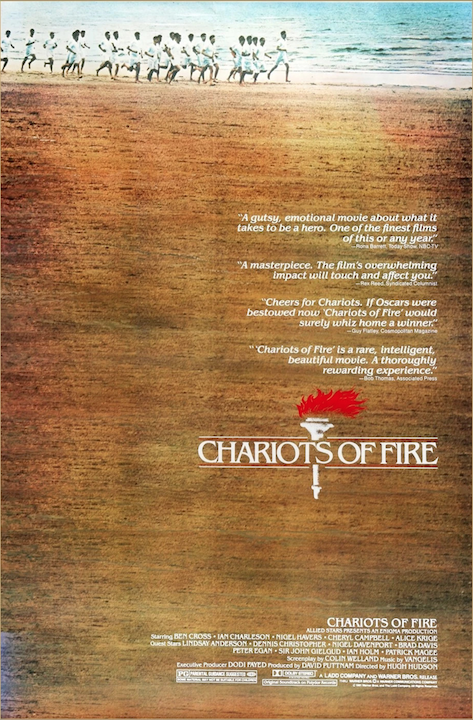
Chariots of Fire (Hugh Hudson, 1981)

I'm not sure how fresh 1981 audiences found the spinning newspapers, training montages, overused sound advances, and witless dialogue ("So where does the power come from to see the race to its end?" "From within." For real??). But today, this dreary biopic comes off like an SNL parody. It's not even all that solid as a narrative; Harold and Sybil meet in one scene and they're already an item making heavy life decisions in the next? That's Oscar material? Yes. The only thing that could save it is amped-up homoeroticism and Top Gun surpassed it in that realm. As parables about the waning of empire go, I'll take Titanic.

Grade: C and dropping

Labels: , ,

Saturday, May 29, 2021

Army of the Dead (Zack Snyder, 2021)

Corporate, soulless, risible (gee, guess which Cranberries song scores the climactic scene), Army of the Dead drains all life from the viewer as it sediments into a clockwork narrative structure. Snyder has inserted some nifty variations on the zombie theme; the undead here hibernate and have formed into different classes. There's even a zombie tiger! But all that charity is nulled by the dreariest variation imaginable - these zombies can reproduce and thus, Snyder saps our attention with a central heterosexual  couple and a family drama to mirror those in the human story. Which latter, by the way, has all the rhythmic propulsion of a zombie dragging its semi-detached leg. Army of the Dead is seven deadening minutes longer than the Cannes cut of Romero's Dawn of the Dead (1978) not to mention 48 minutes longer than Snyder's 2004 remake of same which remains far and away his best film (although somehow I missed 2010's Legend of the Guardians: The Owls of Ga'Hoole). I do too want mainstream Hollywood cinema. I just want it to (handclap) tell (handclap) different (handclap) stories. Tighter ones too. 

Grade: a charitable D


Labels:

Thursday, May 27, 2021

Two for the Road (Stanley Donen, 1967)

I'm in a tailspin when I find myself agreeing with Pauline Kael instead of Dave Kehr. Kehr calls Two for the Road "arguably Stanley Donen's masterpiece" (oooh let's argue) whereas in 5,001 Nights at the Movies, Kael accurately targets "tedious running jokes" and concludes "the facile, comic bits set off audience expectations that are then betrayed, and the clever, bitter stuff just seems sour." For me, Two for the Road goes in my fundamental attribution error category not because the film commits it per se but because its obsessive focus on the heterosexual couple to the detriment of all other considerations contributes to the environment in which such errors are committed. 

For many, that's Two for the Road's most winning quality. In Danny Peary's Cult Movies, Henry Blinder praises screenwriter Frederic Raphael's "desire to create a film in which characters would simply 'live their lives'...[and] avoid, as much as possible, having characters that would represent anything: not the 'impossibility of human communications,' not the 'desirability of the married state.'" If that sounds compelling to you or even at all unique (don't most mainstream Hollywood films operate this way?), then you're free to find yourself in Audrey and Albert's cutesy, temporally jumbled, exquisitely costumed foibles. Me, I'll stick with Hiroshima Mon Amour and The Palm Beach Story, both of which imagine wider, richer contexts beyond their characters' most immediate self-regard.

Grade: B-minus


Labels: , ,

Wednesday, May 19, 2021

The President's Analyst (Theodore J. Flicker, 1967)

I take the positive reviews of The President's Analyst from Dave Kehr, Jonathan Rosenbaum, and Leonard Maltin (four stars!) (not to mention mountains of IMDb raves) as the final proof that I am constitutionally unable to receive satire because I found this hip, paranoid comedy utterly insufferable. Crazy inventive with a refreshing episodic structure, each skit nevertheless feels interminable; it took me three days to watch the thing. Flicker (what a name!) lacks the intensity that Aram Avakian brought to End of the Road (1970) or the consistent world view that Otto Preminger infused into Skidoo (1968), two much better films with similarly wacky dispositions. Instead, The President's Analyst just sits there all smug and confident in its ability to make you laugh. For once in my life, I wanted to leave a party early.

Grade: C+


Labels: