Dionne Warwick: The Windows of the World (Scepter, 1967)
At the time, purchasing this 33-minute LP would have been a no-brainer given the four Bacharach-David cuts now familiar to anyone who's owned one of Warwick's myriad 1960s collections - the heart-yanking and eccentrically structured (there's no middle eight!) title track and "(There's) Always Something There to Remind Me" (both A-plusses), "I Say a Little Prayer" (A), and "Another Night" (high A-minus). Then, in a preview of the early-aughts mashup vogue, there's a version of West Side Story's "Somewhere" sang over "Cool" with 11-pm gusto. Warwick takes the Bert Kaempfert/Milt Gabler chestnut "L-O-V-E" (presented with no dashes here) as a childlike, whispery sex kitten (!) before dropping into her normal register and then ending on a parodic yodel to compliment the jokey wah-wah trumpet. Either the wine was flowing heavily in the studio that day or all involved hated the song (or both). Then we have two movie songs - "What's Good About Goodbye" sung by Tony Martin in the camp classic Casbah (John Berry, 1948) starring Yvonne De Carlo and Dory/André Previn's "You're Gonna Hear From Me" from Inside Daisy Clover (Robert Mulligan, 1965), both shouted with more 11-pm gusto. And then there's filler. Grade assured by the four A-level classics and the aspirational travel agency cover photo.
Cats - The Jellicle Ball, Perelman Performing Arts Center, New York City (July 10)
Even lovers of Andrew Lloyd Webber's 1981 musical Cats must concede that its first act especially is confusing
which only underlines the problem with the through-sung musical - it's difficult to advance narrative through song. That's what all those recitatives and subtitles and program notes in opera are for. Those not enthralled by the spectacle or Webber's score have checked out in bewilderment by the third number. Cats has long since been Exhibit A for anyone disdainful of musical theatre - low-nutrition, flat-bottomed, readymade for tourists instead of the Serious Theatergoer. So when a friend invited me along to see Cats - The Jellicle Ball, a reimagining of the show told through the prism of the queer ballroom culture excavated by Paris is Burning (Jennie Livingston, 1990), I wasn't expecting much, perhaps an episode of Pose bedizened with "Memory" and a few of the peppier numbers. What I couldn't have imagined is how utterly it would overwhelm me for all of its 2.5 hours. After over forty years, with direction by by Zhailon Levingston and Bill Rauch and choreography by Arturo Lyons and Omari Wiles, Cats is finally a Great Musical.
The reimagining is both radical and not. This is basically a production of Cats. No noticeable numbers or characters are eliminated or added. So the confusion remains, solidifying the notion that Cats is at heart a non-narrative show. The story concerns a clutter of cats vying for the chance to gain a new life in a celestial body called the Heaviside Layer. But this overall arc gets lost in the show's contest structure which gives each cat the spotlight for a number or two in an attempt to dazzle us. The genius of The Jellicle Ball is in realizing how perfectly Cats and ballroom culture work together. Drag balls are contests, not stories. They roll out categories (recall those from Paris is Burning such as Schoolboy/girl Realness, Town and Country, or Butch Queen First Time in Drags at a Ball) and a panel of judges declares a winner within each. With that structure in place, one gleaned by anyone familiar with RuPaul's Drag Race or HBO's Legendary, the audience is freed of narrative expectation. The cast aren't even cats; they're mostly Black and Latinx, mostly queer ball contenders. They're there to serve sickening looks and moves down the catwalk to get tens across the board and snatch a trophy. We are at a ball, not a diegetic event eliciting docile voyeurism, and thus, the production encourages the audience to honor the titanic talent on display with fan thworps and spontaneous hollering for an altogether immersive experience. As a gay man comfortable with jettisoning narrative and bored with distended second acts, I've never had more fun or been more moved at the theatre.
Part of how The Jellicle Ball keeps the excitement up throughout is that every moment is suffused with the energy of the house and disco music heard at balls. This is not only a matter of undergirding the songs with an electronic dance beat; the staging and choreography emulate the very structure of disco and house music. Both related genres often rely on the break for their effectiveness on the dancefloor. The break is that part of the track where most of the elements drop out leaving only the percussion or perhaps the vocals to proceed. When the rest of the music finally returns (labeled the drop in DJ parlance), the effect can be so kinetic that dancers will wave their hands in the air, screaming and blowing whistles and ripping off their shirts in orgasmic ecstasy. A classic example is Armand Van Helden ft. Roland Clark's 1999 "Flowerz" with the break starting around 5:38 and the megaton drop occurring at 7:39 in this video.
Nowhere is this more apparent than in the opening ensemble number "Prologue: Jellicle Songs for Jellicle Cats." The song builds in intensity until the backbeat slows and soon stops, allowing the cats to sing as an angelic choir. And then the number slams right back into a fast-paced chorus as if it never left. It's a spritzy enough moment in the original. But The Jellicle Ball sets it on fire. The ensemble is gathered at the far end of the runway for the angelic chorus. And when the drop occurs, they march down the runway in Chorus Line-precision sync with choreography evoking the catwalk moves of ball culture. The effect is like watching a stream of fabulous queer bodies shoot out of a canon, surpassing even the drop in "Flowerz" in intensity. It so overwhelmed me that I could've ran to the nearest corner and crouched down to sob. I feel lucky to have witnessed it. Recognizing that this is their money shot, The Perelman Performing Arts Center has chosen a rehearsal of this very moment to advertise the show generating over a million views on Instagram and kicking off a viral dance challenge.
Anyone still requiring a three-act structure with psychologically well-rounded characters will recoil from The Jellicle Ball. Indeed, one might even claim that the non-narrative framework robs the Black and Latinx queer characters of their chance to tell their stories. But Cats is skeletal enough that The Jellicle Ball never falls into the trap of plastic representation - inserting BIPOC representation into a structure with no BIPOC import. Because the spatiotemporal nature of Cats is so fantastical and non-specific, the Jellicle Cats can occupy it without paying fealty to a diegesis unrelated to their lives. Their stories, their critical thought, their dismantling of the master's tools occur through their bodies which can travserse and abandon space as ball participants have done with gymnasiums, rec centers, dance halls, etc. André De Shields as Old Deuteronomy says precious few words. His age-etched visage brings the past to bear on the proceedings and commands respect with nary a muscle twitch. Junior LaBeija (the queen who spells out "opulence" in Paris is Burning) as Gus sits at a sideline table during intermission, radiating fabulosity in leopard print and long gold nails. And each incredible performer speaks to us in death drops and duck walks as much as through Webber's songs.
I doubt one could apply ball to any show. Titanic or Wicked or Phantom are too localized to stave off plastic representation (although Pippin provides an enticing possibility). And I doubt The Jellicle Ball would survive a move up to Broadway. The ball effect would become diluted up in the nosebleeds of a cavernous theatre. But unsurprisingly, the show's run at the Perelman, way downtown by One World Trade Center, has been extended to August 11th as of this writing. This is my paltry attempt to make sure it doesn't stop there.
Sweeney Todd: The Demon Barber of Fleet Street (Lunt-Fontanne Theatre, September 17, 2023)
The performance of Sweeney Todd: The Demon Barber of Fleet Street at the Lunt-Fontanne Theatre last Sunday was the first Stephen Sondheim show to leave me underwhelmed. But I'm struggling to posit reasons why. Maybe I remain too in awe of the first Sweeney Todd I saw, the 1982 TV movie with Angela Lansbury and George Hearn as Mrs. Lovett and Todd, respectively. Maybe the leads were miscast. Annaleigh Ashford and Nicholas Christopher (filling in for Josh Groban which was why our tickets were cheaper than usual) possess gargantuan talent, especially Christopher who was dripping with sweat for many minutes after a fiery "Epiphany." But both seemed too young for the roles (as I suspect Groban is too) and neither were as rotted or scary as Lansbury and Hearn. And maybe, just maybe, Sweeney Todd pales in comparison to Company, Into the Woods, Assassins, etc. For once, a Sondheim musical bore the two negative hallmarks of a Broadway show - too long and too many ballads. Still, nothing could detract from the power of the best number - "The Ballad Of Sweeney Todd" which opens and closes the show and is reprised throughout. That's because, as always, it's an ensemble number, Broadway's greatest gift to humankind. With queerly high tenors and screeching sopranos building to near glossolalia, Sondheim skirts the edge of chaos. To quote Salieri in Amadeus, it was both terrifying and wonderful to watch.
1.The novels of Ivy Compton-Burnett. Cited by Sontag as part of the canon of camp, Compton-Burnett's novels are comprised almost entirely of dialogue. To borrow film terms, there are few long or even medium shots and no establishing shots. Close-ups dominate such that the reader has no clue who else may be in the same room with the characters chattering at present. They exist only as they speak, closely miked, as it were. This is the camp component. The characters, families engaged in financial squabbles with the help and select neighbors providing mordant commentary, exploit linguistic style to gain an ever-shifting upper hand. Each thesis is met with an exacting, exhausting antithesis in endless verbal skirmishes. The perceived self matters not a whit in Compton-Burnett's world. What counts is the presenting self's ability to wield language as protective armor as epitomized by this astonishing exchange from Darkness and Day (1951) between Bridget and Edmund, a married couple with children who have just discovered that they are not, in fact, father and daughter [sic]:
"We have one gain, an ordinary daily life. Did we like it so much when we had it?"
"We shall like it now. We shall rise and speak and move in the common light of day. Our words will have their meaning. They will have none that is for ourselves. We shall not be afraid of what sounds beneath them, of what is heard through them." (164)
The tragedy here is not the threat of incest but rather the loss of a public self with which to shield oneself from convention. What then emerges across nineteen similarly styled novels published between 1925 and 1971 (I've downed three - the aforementioned Darkness and Day, 1925's Pastors and Masters, her first novel in the style, and The Last and the First, published posthumously in 1971) is not only a respect for camp as a survival strategy but a palpable intelligence behind such extreme emissions. The reader longs to get to that self underneath these battles in dialogue, an unattainable goal that ensures an obsessive drive to consume the next Ivy Compton-Burnett novel. My strong suggestion for newbies is to have Violet Powell's A Compton-Burnett Compendium (Heinemann, 1973) nearby which provides straight-forward synopses of each novel. You're going to need them.
2. Elizabeth Taylor, Angel (1957). Angelica Deverell, "too good a name to be true," indulges in no social niceties ("ignorant of convention as she is scornful of it") and cannot read sarcasm. She trusts not her senses but her idealistic imagination and reality be damned if it impinges on her dream womb. She's altogether insufferable to anyone in her orbit. And despite, if not because, of all this, she becomes a successful romance novelist. As befits someone who counts kitschmeister Frederic Leighton among her favorite painters, Angel writes novels of a gargantuan floridity. We know because Taylor provides a hilarious parody of her style (a "nay" on every page and "coruscating" attached to dozens of nouns). Critics ridicule her, editors try to curb her more rococo flourishes. But Angel holds fast and sells mountains of books. This affords her the potential to live the romantic life of her characters. Unfortunately, pesky reality has other plans. Her husband, a talentless painter named Esmé, keeps a mistress in London. The world wars are inconveniences, especially when Esmé enlists against her wishes. She pens antiwar screeds which tanks her popularity. And her palatial estate, Paradise House, devolves into a Grey Gardens. Even the peacocks she purchased fail to fan their feathers and instead shit all over her terrace. Taylor traces Angel's decline with a tart, Flaubertian irony. But she sketches Angel's uncompromising nature so indelibly that you can't help but admire the punk Barbara Cartland that results. "Always too busy writing about what she thought of as ‘nature’ to go out of doors to look at things," Angel reminds one of Peggy Gravel bitching about trees stealing her oxygen in Desperate Living (John Waters, 1977). And in her claiming that “we may all be equal in the sight of God...but we are not all equal in my eyes,” one spots Patti Smith's "Jesus died for somebody's sins but not mine" on the horizon.
3. Angel (François Ozon, 2007). Ozon gets it. In this savvy adaptation of Taylor's novel, he gives Angel (Romola Garai) the romantic mise-en-scène she craves so much. Cheesy rear projection lets her travel around the world. Esmé is played by an irresistible Michael Fassbender. And right before Angel drops dead, she lets forth with a preposterous "I am Angel Deverell!" But no matter how hard she tries to live in one of her novels, she cannot escape her rotten personality, leaving the Harlequin romance existence forever out of reach.
4. Jane Bowles, Two Serious Ladies (1943). More difficult people including a Miss Goering who is “used to forcing people into conversation, her fears never having been of a social nature.” Tennessee Williams' favorite novel, Two Serious Ladies is peopled with characters who, when they aren't being mean to one another, exhibit baffling motivation. In bad decision after bad decision, Mrs. Copperfield and Miss Goering go on separate tawdry journeys, the former falling in love with a prostitute in Panama, the latter shacking up with a series of no-goodniks possibly on Staten Island. These two serious ladies are after transcendence, a going to pieces which grants them authority and daring. They meet in the last few pages but the summit yields only more insults. Alone at the end, Miss Goering fancies herself a saint. But she has no followers, a code she doesn't use, and in the last sentence, deems the matter to be "of no great importance." In short, a Fassbinder film avant la lettre.
5. Jonny Gators, Kodachrome 40 Super 8 reversal processing first attempt. Not good. Beach. (YouTube, 2022). Not good, indeed. Great! I learned such terms as "lomo tank" and "caffenol reversal process" from this apparent failure to develop a bit of Super 8 ("Worst roll yet, ugh"). But it turns out to be an absolutely gorgeous experimental film. "Could use some pointers at this point, I suppose." Sure, keep fucking up!
6. Diana Hubbell, "How America Embraced Aspics With Threatening Auras," Gastro Obscura(May 10, 2022). As a veteran of the jellied pork at the Ukrainian East Village Restaurant, I was hungry for this serious inquiry into the past and future of aspics. Formerly a method of food safety, aspics are now haute cuisine at finer establishments. Check out the takoyaki-inspired aspic with baby octopuses in sake-infused jelly below. But most intriguing was the suggestion that the mid-twentieth-century gelatin horrors we love to ridicule today were the product of home economics pioneers like Lillian Gilbreth and Ellen Richards frustrated at being locked out of the "masculine" realms of science.
7. Ozark (Netflix, 2017-2022). The inability of serial television writers to take larger narrative arcs into consideration reaches its sloppy apotheosis here, one hopes. An office is blown up in season two but the destruction is completely forgotten as season three begins. No mention of clean up and never ever any indication of how such violence might impact the characters. Just keep the stay-at-homes streaming. Luckily, I stuck around for the series finale which offered an unforgiving glimpse into how the white, middle-unto-upper-class central couple of Marty and Wendy Byrde (Jason Bateman and Laura Linney) manage to retain their privilege. And helping it all go down was Julia Garner in a performance for the ages as Ruth fuckin' Langmore as my friend Charles rightfully calls her.
8. The Lion King, Minskoff Theatre (September 4).Dump your second acts, Broadway! I begrudgingly admit that the spectacle held me for a good half hour. But then the story kicks in and soon, I was making common cause with the fidgety nine-year-old in front of me. And this was before intermission at which point I heard a mother tell her even younger child, "there's a whole other part." Tragic but true, kid. And yet, I did get choked up, not during the lethally dull second act but when Scar took his bow at the end. I honestly assumed everyone would boo him. Instead, he received just as much love as Simba and Mufasa. Poke fun at the musical all you want, Hell, I'll join you now and then. But no other genre has that capacity for community formation and collective regard.
9. Alfredo Jaar, 06.01.2020 18.39, 2022, video projection, sound, and fans.
This installation at the 2022 Whitney Biennial evokes the National Guard helicopters flying low enough to disperse Black Lives Matters protests in Washington D.C.'s Lafayette Square before Trump's photo op in front of St. John's Church. Patrons were allowed in only at certain intervals so as to experience the five-minute video document in its full horror. But Jaar needn't have worried about diluted impact. It's the sound of the six overhead fans that made us feel the chaos of that day, a sound one could hear roaring at any point on the sixth floor of the Whitney.
10. The Paranoid Style: For Executive Meeting (Bar/None, 2022). At first, Elizabeth Nelson doesn't seem like your bohemian compatriot. Her music is unfashionable demo-style pop-rock. She recently dissed chattering class bands like Vampire Weekend and Arcade Fire. And worst of all, she likes golf. But if there's someone recording brainier, more boho songs, gimme their Bandcamp. Did you know that Steve Cropper played guitar on Big Star's cover of "Femme Fatale"? Did you know that the Box Tops recorded a version of "A Whiter Shade of Pale"? Do you know who Barney Bubbles was? You can learn all this and more on For Executive Meeting, Nelson's latest full-length. Oh you knew all that? OK, then how about a mind attuned enough to describe home ownership as "houses pre-haunted"? She ain't heavy, she's your sister.
The Mr. surprised me with a ticket to see Tina: The Tina Turner Musical Saturday, October 30th at the Lunt-Fontanne Theatre with the incomparable Adrienne Warren in her last performance (or close to it) as Tina Turner. As usual, I had mixed feelings.
Starting with the bad, why oh why are almost all second acts of Broadway musicals so criminally boring?!? I asked this of my pal Jody and she offered, "because shows don’t need second acts. They should just have a killer first act and charge less!" And deader-on words were never Facebook Messengered. One theory holds that the second act is where the dramaturgists (here, Katori Hall, Frank Ketelaar, and Kees Prins) hang most of the story information out to dry. But the problem seems simpler than that - mainly, a concentration of ballads. Even my beloved Xanadu (the film!) features just such a misstep in "Suspended in Time." One ballad is often bad enough. But several have you wondering if Junior's is open after 11pm (it is!).
Also, the audience around us was poorly behaved during the second act - chatting, on their phones, etc. Maybe they had too much to drink and/or they were rightly bored. Or maybe this is the fate of the jukebox musical. Broadway music, especially in its post-Show Boat incarnation, does not call for a direct engagement with the audience. But rock 'n' roll does which places the jukebox musical in an itchy spot. For instance, one scene in Tina recreates Turner's triumphant gig at The Ritz. Warren as Turner even welcomes us to The Ritz and elicits a response from the audience. Of course, we aren't supposed to actually respond just as we aren't supposed to look over our shoulder when a character sees something in the distance/at the back of the theatre. Nevertheless, that tighter performer/audience bond characteristic of rock 'n' roll gives some theatergoers the license (or so they perceive) to chat and respond back and check messages on their phones. Luckily, no one lit up a cigarette.
As for the great, the moment in which Turner records "River Deep, Mountain High" was a masterpiece of staging, set design, and incendiary performance. Weasely Phil Spector hops up in his production booth and lords over the recording like some demented deity. Turner is alone in front of a giant wall meant to stand in for Spector's Wall of Sound. And after several run-throughs of the opening vocal (which the real Turner was never quite sure she got right), she belts out the song in competition with the Wall and comes out if not victorious, then on equal standing which is incredible enough given Spector's typical cacophony.
The scene after takes place years later in the home of Ike and Tina Turner. But even though the new set slid into place in mere seconds, we would not let the show continue due to several minutes of applauding. Warren stood in place and waited for the hooting to die down. There were even calls for an encore which was presumably impossible since the narrative had already moved on. Or rather, tried to move on. Al Jolson would have complied. But his standard of story-pausing audience interaction hasn't been the norm in about 100 years. Warren eventually gestured slightly with her hands for us to sit down. But for a good three or four minutes, Broadway and rock 'n' roll felt as one - the audience feeding off the performer, the audience feeding off each other, the performer feeding off of us. It's a moment I feel privileged to have witnessed.
I've always preferred the film musical over the stage musical for good old fashioned communist reasons - it's buckets cheaper and you can share it with more people. Vagaries of context can undoubtedly inform film reception. But in general, the 1962 film version of Gypsy you saw is the same one I saw and we can discuss it accordingly. When you tell us you had the privilege of seeing Ethel Merman in the original Broadway production of Gypsy, all we can do is hang on to your memories and maybe utter a bitter "jerk" under our breaths.
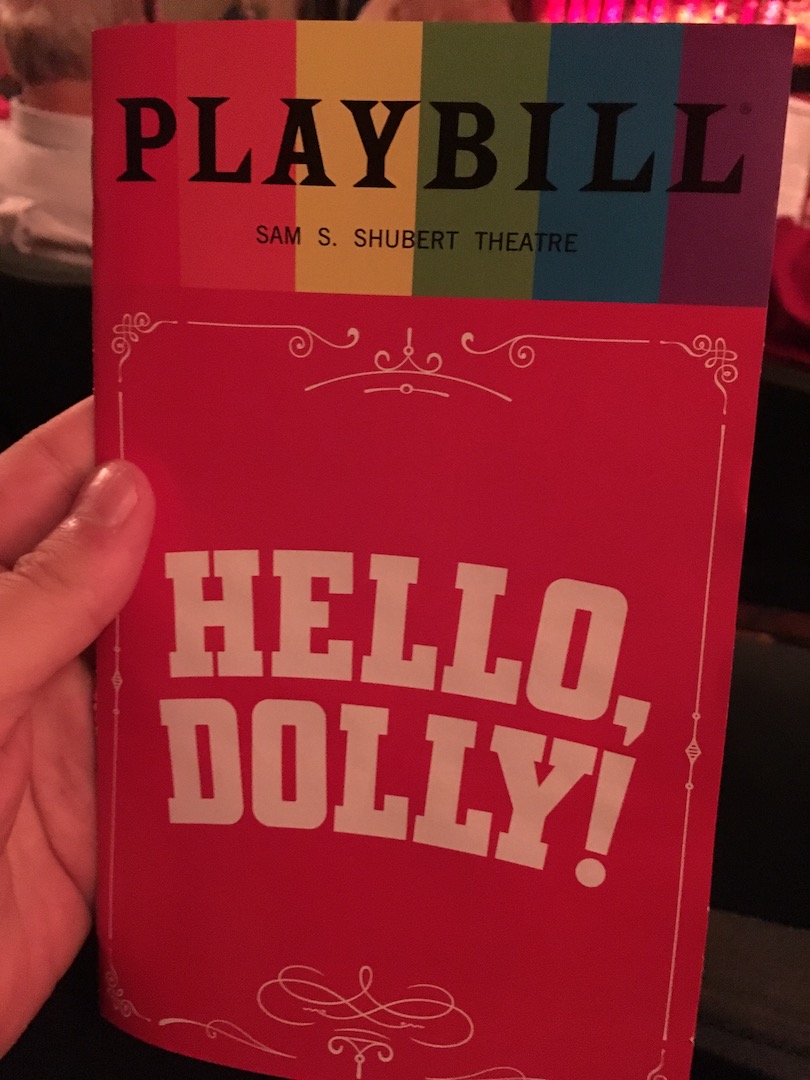
So I wasn't excited when a friend offered me in a block of tickets to see (it better be) Bette Midler in Hello, Dolly! at the Shubert Theatre. The few touring shows I'd managed to take in around 2000 in Milwaukee (Cabaret, Sunset Boulevard with Petula Clark, and, was it?, The King and I) left me underwhelmed at best. And I despised the grotesquely distended 1969 film version of Hello, Dolly! featuring a ridiculously miscast/shoehorned-in Barbra Streisand. But I'd never been to a Broadway show. And I adored Midler's early 1970s pomo rewiring of popular music history even though she quickly abandoned this project for the schlocky half-measures and compromises of El Lay. So I went in expecting to get all haughty about a moribund art form and two and a half hours later left with tears in my eyes.
First, the bad. $152 for one ticket. Go around the corner to the AMC Empire 25 on 42nd St. and you can pay about $18 to see a first-run movie. Still a despicable price but you can see eight movies for one Dolly. Or better yet, trek down to my favorite movie theatre in New York City, Anthology Film Archives, and purchase a general admission ticket for $11 and see some of the greatest films ever made. As much as I loved my time at Dolly, it cannot match the out-of-body experience I had watching Mosaik Im Vertrauen (Peter Kubelka, 1955) at Anthology in September last year.
Also, the seats. We were in the last row of the mezzanine (my seat was K 23) and had a remarkably unobstructed view for such a thin field of vision. But we missed some action on the upper floor of Vandergelder's Hay and Feed Store and, worse, Dolly's entrance at the Harmonia Gardens Restaurant. And the standing ovation completely obstructed the curtain call. But I followed the Broadway veteran (of several shows just that week!) in K 25 down the aisle to at least Row F to get a better view.
Overall, though, I remain stunned by how moved I was. It had little to do with Midler. I teared up when she asked her dead husband Ephraim to give her a sign that it was okay to marry Vandergelder. But the moments that really choked me up were, well, good old fashioned communist ones - ensemble numbers like "Before the Parade Passes By," "Hello, Dolly!," the finale, all amplified by Warren Carlyle's choreography, built on Gower Champion's original work,
no less astonishing in the serpentine movements throughout the Hay and Feed Store during "It Takes A Woman" than in "The Waiters' Gallop." If we cry at melodramas because of the impossibility of communication, we do so at musicals for the opposite reason - that disparate people can come together like rama lama lama. And Midler's star wattage is crucial for this effect. Donna Murphy, whom I never even heard of until this weekend (chill, theatre queens), will no doubt sing the role better on Tuesdays as Midler herself would probably concede. But the ensemble effect of the musical subsumes even a supernova like Midler and for an overwhelming moment, we are all one.
It's a fleeting moment for sure, especially with $59 for the cheapest ticket. I certainly don't want to make common cause with the audience if they agree with Ben Brantley's contention in a depressing New York Times review that there was "a more innocent age of American history" or that camp doesn't exude "bone-deep affection and respect." And I definitely want to avoid the two psycho fans I encountered afterward whom I tried to convince that Midler had left the building and was whisked away in a car the nanosecond she left the stage. But the show taught me what it might feel like to make common cause with them and I am privileged to have witnessed it.
.jpg)


.jpg)