Wednesday, November 10, 2021

The Mad Max Trilogy!

Mad Max (George Miller, 1979) is like the first hideous draft of a student essay whereas The Road Warrior (aka Mad Max 2) (George Miller, 1981) is what happens after, I'll be blunt, I take a red pen to Mad Max and correct the rather fundamental mistakes. I mean, like wow. Where are we at? WHEN are we even at? This is supposed to be post-apocalyptic? How do we know? What is the point of the night club scene? Why does the head mean dude lead the other mean dude into the water? Why is Brian May's score blaring over basic dialogue? And, the most pressing question of all, how on earth did this gross $100 million while its infinitely superior sequel grossed only $36 million? Were 1970s folk still hankering for Walking Tall/Death Wish revenge fantasies as late as 1979? Guess so.

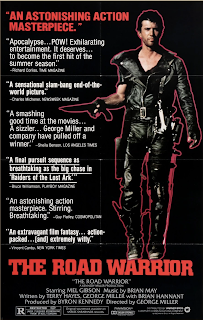
The Road Warrior is three minutes longer but feels 45 minutes shorter. Miller takes just a few moments to set up the basic narrative premise. Was that so hard? And then, even better, he wastes no time with boring characterization or subplots. We get strapped into the rollercoaster and it doesn't stop blowing our wigs until the final credits. And, gawd bless close captioning, did you know the bad guys are called Smegma Crazies and Gayboy Berserkers? Tight, imaginative, with a twist modestly foreshadowed early on, this zero-body-fat actioner seems so easy that you wonder why there aren't dozens more.

Mad Max Beyond Thunderdome (George Miller and George Ogilvie, 1985) uses its bigger budget to dazzling effect. In place of the sere visuals of the first two, Miller gives us Bartertown, a ramshackle colony run on pig shit and lorded over by Tina Turner as Aunty. The byzantine design is mirrored in the city's elaborate codes of conduct, a few of which are chanted by the inhabitants, e.g., "Bust a Deal, Face the Wheel," "Aunty's Choice" being one of the wheel options. Who wants life beyond the thunderdome when it's so fun here? Miller even maintains our interest in the dreamier middle section in which a group a children in dire need a conditioner engage in some seriously distorted oral culture. But the third act sags in what amounts to an empty retread of The Road Warrior. Great theme song, though.

Mad Max: C

The Road Warrior: A-minus

Mad Max Beyond Thunderdome: B+
Labels: , ,

Wednesday, November 03, 2021

Tina: The Tina Turner Musical

The Mr. surprised me with a ticket to see Tina: The Tina Turner Musical Saturday, October 30th at the Lunt-Fontanne Theatre with the incomparable Adrienne Warren in her last performance (or close to it) as Tina Turner. As usual, I had mixed feelings. 

Starting with the bad, why oh why are almost all second acts of Broadway musicals so criminally boring?!? I asked this of my pal Jody and she offered, "because shows don’t need second acts. They should just have a killer first act and charge less!" And deader-on words were never Facebook Messengered. One theory holds that the second act is where the dramaturgists (here, Katori Hall, Frank Ketelaar, and Kees Prins) hang most of the story information out to dry. But the problem seems simpler than that - mainly, a concentration of ballads. Even my beloved Xanadu (the film!) features just such a misstep in "Suspended in Time." One ballad is often bad enough. But several have you wondering if Junior's is open after 11pm (it is!). 

Also, the audience around us was poorly behaved during the second act - chatting, on their phones, etc. Maybe they had too much to drink and/or they were rightly bored. Or maybe this is the fate of the jukebox musical. Broadway music, especially in its post-Show Boat incarnation, does not call for a direct engagement with the audience. But rock 'n' roll does which places the jukebox musical in an itchy spot. For instance, one scene in Tina recreates Turner's triumphant gig at The Ritz. Warren as Turner even welcomes us to The Ritz and elicits a response from the audience. Of course, we aren't supposed to actually respond just as we aren't supposed to look over our shoulder when a character sees something in the distance/at the back of the theatre. Nevertheless, that tighter performer/audience bond characteristic of rock 'n' roll gives some theatergoers the license (or so they perceive) to chat and respond back and check messages on their phones. Luckily, no one lit up a cigarette.

As for the great, the moment in which Turner records "River Deep, Mountain High" was a masterpiece of staging, set design, and incendiary performance. Weasely Phil Spector hops up in his production booth and lords over the recording like some demented deity. Turner is alone in front of a giant wall meant to stand in for Spector's Wall of Sound. And after several run-throughs of the opening vocal (which the real Turner was never quite sure she got right), she belts out the song in competition with the Wall and comes out if not victorious, then on equal standing which is incredible enough given Spector's typical cacophony. 

The scene after takes place years later in the home of Ike and Tina Turner. But even though the new set slid into place in mere seconds, we would not let the show continue due to several minutes of applauding. Warren stood in place and waited for the hooting to die down. There were even calls for an encore which was presumably impossible since the narrative had already moved on. Or rather, tried to move on. Al Jolson would have complied. But his standard of story-pausing audience interaction hasn't been the norm in about 100 years. Warren eventually gestured slightly with her hands for us to sit down. But for a good three or four minutes, Broadway and rock 'n' roll felt as one - the audience feeding off the performer, the audience feeding off each other, the performer feeding off of us. It's a moment I feel privileged to have witnessed.


Labels: ,