Wednesday, October 22, 2025

New York Film Festival - Fourth Dispatch

The Secret Agent (Kleber Mendonça Filho) - Wagner Moura gives an electric performance as a dissident in 1977 Brazil who finds precarious protection amongst a shelter for political refugees before attempting to flee the country. Those who fell for the Oscar-validated I'm Still Here (Walter Salles, 2024) should enjoy this adept thriller skewering the Brazilian military dictatorship of the era. But at 158 minutes, it overstays its welcome. And it betrays a straightforward conventionality unworthy of the dislocations of Filho's Bacurau (2019), one of the finest films of our rapidly aging century. 

Grade: B+ 

Duse (Pietro Marcello) - I first heard of the legendary actress and Sarah Bernhardt rival Eleonora Duse (1858-1924) from All About Eve in Bill's rant to Eve about what The Theatre means (although my preteen, pre-internet mind heard it as "Eleanor Adusa"). Then for forty years, I never gave her another thought until this most welcome biopic. Marcello picks up Duse's story in the last act of her life, past previous glories and desperate to find her way back to audiences scarred by WWI. She even breaks bread with Mussolini over a doomed plan to recreate Athens in Italy. It's the kind of narrative that would have worked well with the anachronisms Marcello sprinkled throughout Martin Eden (2019), another film about a fiery artistic temperament. Like The Secret Agent, unfortunately, there's a safe, Oscary feel to the project that makes one long for the lopsided structure of Martin Eden or the proto-art-film longueurs of the Italian diva film of the 1910s. That it all still works is testament to Valeria Bruni Tedeschi's blistering performance as Duse. Out of historical sync, in tears 90% of the time, Tedeschi's Duse exhausts herself trying to find a time and a place for her art. A full century after her death, she feels right at home in 2025. 

Grade: A-minus

Labels: , , , ,

Saturday, October 18, 2025

New York Film Festival - Third Dispatch

Rose of Nevada (Mark Jenkin) - I'll be blunt. I admired Jenkin's Enys Men (2022) as a perplexing mood piece. But I opted for his latest feature solely because I thought it would allow me to be in the same room with the co-star of the film, George MacKay, the architecturally gorgeous actor who appeared in two of my favorite recent films, The End (Joshua Oppenheimer, 2024) and best-film-of-the-decade-candidate The Beast (Bertrand Bonello, 2023). Alas, the beauty was not in attendance. Still, I wasn't aware of his absence until after the screening so I received Jenkin's latest Cornwall puzzle with an open mind if not heart. 

McKay plays Nick, a fisherman from a present-day, rundown Cornish village who goes off with drifter Liam (Callum Turner, perhaps even more gorgeous but lacking the angularity that makes MacKay's face so delectable for filmic compositions) on the titular watercraft for a job. They return to find they are back in 1993 when the village was thriving and each subsequent run on the Rose of Nevada tosses them back and forth between the two eras. Jenkin provides narrative tension through the men's divergent reactions to the time jumps. While Nick is understandably baffled and searches for signs of his wife and family, Liam plays the sexual field and may be engaging in some conceptual incest back in the present. Jonathan Romney in Sight & Sound found it "a tale of the fantastic, but rooted in the bleak political realities of 2020s Britain." I found it suffered from the drawbacks of the subgenre - diverting while it plays but easily placed on the shelf with other puzzles and forgotten once it's over, despite its gorgeous 16mm photography and reportedly post-sync sound that make the film look like a lost 1970s folk-horror screamer.

Grade: B+


Sirāt (Óliver Laxe) - Since Laxe's latest shifts into shock mode about halfway through, it's best to keep this short. A father, Luis (Sergi López), with his son, Esteban (Bruno Núñez Arjona), descends upon a rave in a Moroccan desert in search of his daughter who has gone missing. A military unit breaks up the rave and lines up a caravan to be arrested. But along with two groups of revelers, Luis speeds away in his van. They're all off to another rave where Luis hopes he might find his daughter. After changing tires, bartering with locals for gas, and avoiding another military convoy, things take a turn for the even worse. 

Sirāt enjoyed a June release in Spain, doing robust box office figures for an art film. It's also divided audiences pretty starkly; check the array of takes on Letterboxd. I didn't know what to do with it once I stepped off the ride. Since the ensemble are all European, Laxe may be suggesting something about colonialism or locating pleasure zones in the midst of regional conflicts. But where Rose of Nevada is a puzzle, Sirāt is a roller coaster. Extremely gripping, even harrowing, it raises your blood pressure but to what end? Wrong answers only.

Grade: B+

Labels: , ,

Thursday, October 16, 2025

New York Film Festival 2025 - Second Dispatch

Resurrection (Bi Gan) 

The marketing and wide release in China of Gan's previous feature, Long Day's Journey into Night (2018), hoodwinked the moviegoing masses into thinking it was a romantic comedy instead of a drifty art film. Box office figures plummeted after its New Year's Eve opening night and the hashtag "can't understand Long Day's Journey Into Night" started to trend. We'll have to wait to discover if Resurrection (the Chinese title is different and translates as Savage Age) will meet the same fate when it hits general release. I myself felt snookered by the NYFF blurb promising a film "unfolding over five chapters that feature a dazzling array of styles and genres." As with Long Day's Journey into Night and 2015's Kaili Blues, it dazzles, to be sure. Blessed with a hefty budget, a leisurely production schedule (began in 2023, a workprint barely made it to Cannes this May), and superstars Jackson Yee and Shu Qi, Gan indulges in a feckless extravagance. He takes on the entire history of cinema with Caligari and Nosferatu nods, time jumps, and a climax comprised of yet another of his characteristic long-takes, this one lasting 30 minutes. All of this takes place in some sort of time-space continuum in which, as we are told in periodic titles, dreams either no longer exist or are somehow rendered illegal. A band of rebels called Fantasmers still dream, though, including one Frankenstein monster type (Yee) equipped with a film projector in his torso during an early silent sequence. He then reappears in various guises throughout that array of styles and genres.

As you might suspect, none of the above adds up to much in narrative terms. It sustains on mood and visuals alone. I just wish I got the buffet promised. Most of the vignettes traffic in noirish crime and grit which we have a surfeit of on television and in cinema (and in criticism and in academia and...) so lovers of musicals, melodramas, pornography, and westerns are left to f(l)ap in the wind. I also wish I knew what Gan was trying to tell us about the History of Cinema assuming he had any clear viewpoint throughout the two years it took to bring the film to life. And I rue the forthcoming exegeses that will take the framing device too seriously and "explain" how each historical and generic register makes perfect narrative sense, as if that were the heroic goal of all cinema.

Grade: B


Labels: ,

Wednesday, October 15, 2025

New York Film Festival 2025 - First Dispatch

I don't feel comfortable pronouncing on the 63rd New York Film Festival or what it said about the State of Cinema overall given that I saw only nine of the over 100 titles programmed. All I will attest to is my inability to catch a single masterpiece for the second year in a row, a function of time, money, and sticking to directors/subjects I like best. Perhaps next year I'll be reckless enough to choose something outside of my wheelhouse. Or else stick with experimental films, the jazz of cinema - always there, taken for granted, and capable of dazzling you with its risky changes when you deign to check in again. 

Starting with the most infuriating film, I experienced unwelcome déjà vu with one of Richard Linklater's two biopics screening at the festival - Blue Moon, about the Great American Songbook lyricist Lorenz Hart (Nouvelle Vague, the other, concerns Godard and the making of Breathless). Taking place almost entirely on March 31, 1943, the evening Rodgers and Hammerstein's Oklahoma! opened, Blue Moon finds Hart (Ethan Hawke) leaving the show at intermission and hieing to Sardi's where he proceeds to get soused and rue the success of his former writing partner Richard Rodgers (Andrew Scott). For the first half of the film, he holds court in the near-empty bar, swirling vapors of wit and sass around bartender Eddie (Bobby Cannavale) and E. B. White (Patrick Kennedy) writing unobtrusively on the sidelines. Then a triumphant Rodgers and his entourage arrive and Hart puts on a pathetic display trying to rekindle the songwriting spark with Rodgers and introducing him to an ingenue with whom he is inexplicably obsessed, Elizabeth Weiland (Margaret Qualley), an apparently real person who remains a nullity by film's end. 

Writer Robert Kaplow based his screenplay on letters Hart and Weiland wrote one another instead of the most recent biography, Gary Marmorstein's A Ship Without A Sail: The Life of Lorenz Hart (Simon & Schuster, 2012) which imparts a certain documentary value to the undertaking. We ought to embrace such deep dives into the relationships between women and bisexual men (or however we are to ascribe the morass made of sexual identity by the era). But no film is an island and Blue Moon joins De-Lovely (Irwin Winkler, 2004) and the disastrous Maestro (Bradley Cooper, 2023) as yet another nervous attempt to center the heterosexual relationships of queer composers (Cole Porter and Leonard Bernstein in the latter two instances). One need only peep the panicky poster art of each assuring Mr. and Mrs. Popcorn that no deviant sexuality will cross their screens today. Will we not get biopics of Sondheim (who shows up here at 13 years old in a cameo played by Cillian Sullivan), Ebb and Kander, or Ned Rorem because they never married women?

In partial compensation, the performances are uniformly sparkling, especially Hawke who should be a shoo-in for an Oscar nod. And Linklater ventilates his recreation of Sardi's, shot in Dublin, by letting the camera rummage through the bathroom, climb atop the staircase, sneak into the cloak room. The latter location, though, is the setting for a dreary tête-à-tête in which Weiland recounts a recent sexual exploit to Hart with nary a suggestion of how such spaces informed the creation of Hart anti-valentines like "It Never Entered My Mind, "Glad To Be Unhappy," and "Blue Moon" itself. You're better off watching the greatest film of the century instead. 

Grade: B-minus


Labels: , , ,

Friday, October 11, 2024

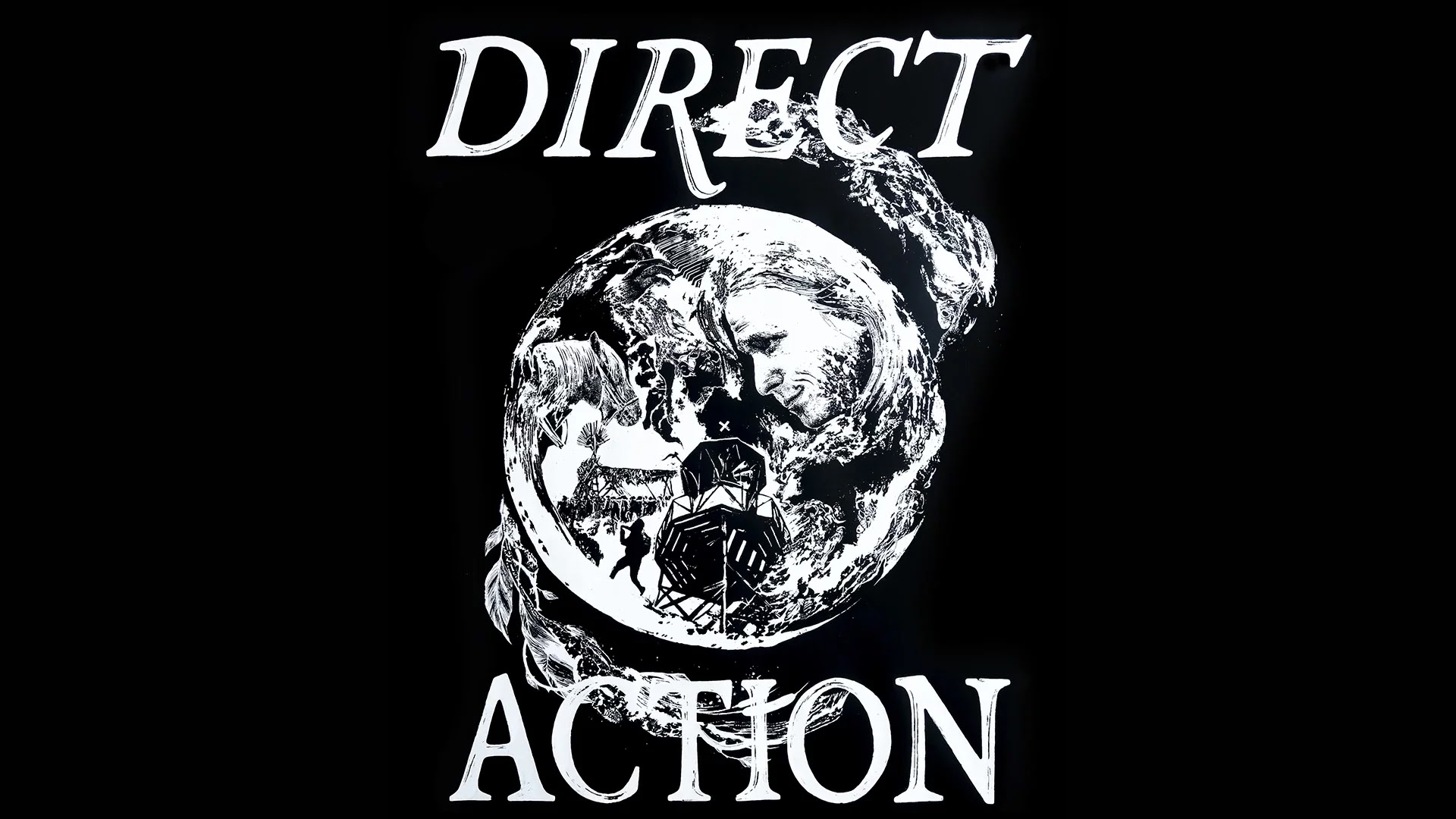
Direct Action (Ben Russell and Guillaume Cailleau, 2024)

Direct Action is a 212-minute documentary comprising just 41 shots observing the daily operations of the Notre-Dame-des-Landes commune, one of the ZAD (Zone à Défendre, or Zone to Defend) communities engaged in eco-activism against the French government. They successfully halted an airport project in 2018 but continue to fight various ecologically destructive initiatives. Russell and Cailleau spent about 100 days filming at the commune's 4,000-acre autonomous zone and despite occasional footage of violent protests, much of Direct Action has a quiet, Jeanne Dielman-like feel to it - long takes of making bread, sawing wood, cooking crepes, gardening, etc. 

About ten minutes into its U.S. premiere Monday night at the New York Film Festival in the Elinor Bunin Munroe Film Center, a loud sound came from the back of the theater. It didn't feel like it came from the film and it had many viewers, myself included, looking around for the source. The sound was of a possibly panicked crowd, quite chaotic and disorienting. Since it kept playing for at least ten minutes, everyone in the audience (again, myself included) took it to be part of the film somehow. The sound played over several cuts which felt sloppy, especially given that one shot was a stationary low angle of a tower and another was a close-up of an activist explaining the best ways to deal with police interrogations.

At one point, the panicked crowd sound traveled to the front of the theater and I began to accept that the film was being accompanied by some sort of sound installation. As I was trying to figure out how the filmmakers achieved this effect, I heard a verbal fight between two women in what I assumed was also part of the sound installation. I prepared to strap myself in for what would promise to be a wild sonic ride; perhaps the filmmakers were using these sounds as a Brechtian distanciation device. 

It was only then that I could discern that an animated audience member was yelling at someone. I adjusted my eyes and finally saw that there were two people standing in front of the screen and staging a protest. They started in the back row and moved up front but I was completely oblivious to all of this activity. I heard "They're aestheticizing direct action rather than engaging in it" and "While you're watching, bombs are dropping!" I filmed about 40 seconds of it which you can see below. The film stopped and security ejected the two protestors.

I spoke with a guy sitting in my row and he noticed that the protestors had a large backpack with them which must have been housing a speaker from which the panicked crowd sound emerged. That would explain how the sound traveled with them to the front of the theater. The film started up again and an employee shouted an apology to us and asked if we wanted the film to start over. After a collective "No!" the film continued with no other interruptions apart from the usual talkers and phone users.

As for the film itself, difficult, rewarding, but I have to concede that the protest made it all the more memorable and, at the very least, an excellent teaching tool for the upcoming sound module in my Introduction to Film course. 

Grade: A-minus


Labels: , ,

The Damned (Roberto Minervini, 2024)

The Damned is purportedly a fiction film with a screenplay written by Minervini. But his m.o. has always been to blend fiction with documentary and it's unclear how much of the dialogue was improvised or how much was influenced by Minervini's discussions with his actors (or entirely the product of Minervini's imagination). Despite a mostly stationary camera, The Damned feels more like a direct cinema documentary than a hermetically sealed diegetic world. In the Winter of 1862, a group of volunteer soldiers are sent to the western territories (specifically, Montana where it was filmed) and, with the Civil War raging back east, they wonder about the purpose of their mission. The film is comprised of disconnected scenes of the men grappling with their day-to-day existence as soldiers - discussing why they joined the army, learning how to scan the landscape for dangers, helping one another with various wounds, trying to find a balance between idealism and cynicism (and perhaps even nihilism), etc. Minervini treats the Civil War with a parallax view at best. As he notes in the press kit, "I wanted to shed the weight of history a little bit to facilitate this experiential journey, to allow for something more cathartic and more primordial to come from within and from these individuals." He achieves this goal as The Damned sweeps you up in the flow of these men trying to find meaning in their work as they try to stay alive. But so far, Roberto Minervini has yet to fulfill the promise of his expansive Louisiana/The Other Side (2015), one of the finest films of the century. Hypnotic as much of The Damned is, it feels slight compared to Louisiana, so rigidly focused that you long for the weight of some other force to bear down on the project, if only to ensure you will recall the film a year from now. 

Grade: A-minus

Labels: , ,

All We Imagine as Light (Payal Kapadia, 2024)

Prabha (Kani Kusruti) and Anu (Divya Prabha) are two Malayali nurses living together in Mumbai. Prabha's husband from an arranged marriage lives in Germany and she hasn't seen him in years. Anu, younger and more idealistic than Prabha, is in love with Shiaz (Hridhu Haroon), a Muslim man, and they're both worried about how Anu's Hindu family will accept the news. An older coworker Parvaty (Chhaya Kadam) is being harassed by her landlord who wants to sell the apartment building in which she resides to real estate developers. She quits her job in disgust and moves back to her seaside village. Prabha and Anu accompany her on the journey and the change of locale, an explicit contrast to the bustle of Mumbai, winds up rejuvenating for all three women.

Before the New York Film Festival screening Monday night, Kapadia explained that the subtitles would indicate which non-Hindi languages were being spoken throughout the film. It's a perfect illustration of how disorienting Mumbai can appear for anyone trying to navigate their lives in the city, with language a specific story point as some characters profess difficulty with learning Hindi. Kapadia's Mumbai is one where people work long hours and then greet insomnia upon finally getting home. Artificial light dominates as day and night become meaningless distinctions, hence the perhaps utopian promise of the film's title. But as much the "imagine" part of the title as the "light." The seaside locale, itself festooned with a variety of party lights, affords the three principals the time for reflection so much so that the climactic event may be entirely the product of Pradha's imagination. It's a beautifully acted, delicately observed film, one that threatens to get lost between brasher films if not in your own overstimulated memory bank.

Grade: A-minus


Labels: ,

Tuesday, October 08, 2024

The Shrouds (David Cronenberg, 2024)

The most straightforward Cronenberg film since A Dangerous Method (2011), The Shrouds tells a downright Oedipal tale of Karsh (Vincent Cassel), a wealthy businessman mourning the loss of his wife, Becca (Diane Kruger). With apparently bottomless reserves of capital, he founds GraveTech, a state-of-the-art graveyard that allows clients to monitor the decaying bodies of their loved ones. The bodies are wrapped in full-coverage shroud technology that facilitates close-up and 360 views of the deceased. One evening, a select number of graves are vandalized, including Becca's, and Kash's IT guy Maury (Guy Pearce), who is unhappily divorced from Becca's sister Terry (also Kruger), eventually regains access to the grave feeds. But he discovers nodes growing on some of the bones (again, including Becca's), nodes that may be surveillance devices. This wrinkle plunges Vincent into a maelstrom of conspiracies and he spends the second half of the film wondering who to trust, even his sexy AI avatar assistant Hunny (also Kruger). 

However convoluted all of that sounds, Cronenberg drops not a single spinning plate over 119 minutes, apart perhaps from a few awkward dream vs. reality moments. In fact, as with Twisters, of all things, I honestly thought there was an hour left to go as the final credits started to roll. But that left an empty feeling that might not work in the film's favor. I kept longing for some pushback from the women characters akin to an early scene in which a first date, Myrna Slotnik (Jennifer Dale), at GraveTech doesn't go too well; in classic feminist film theory mode, Myra makes it clear to Karsh that she does not want to look at Becca's decaying body on the GraveTech monitor. And Kruger's sex-which-is-not-one characters are not so much foils as enigmas helping Karsh speed along his oedipal path towards knowledge. 

Then again, maybe a bit of emptiness is what Cronenberg was after. Karsh is an obvious stand-in for Cronenberg who lost his wife Carolyn to cancer in 2017. He presents himself as a husk incapable of believing that someone so vibrant and alive as Becca (or really anyone?) can just be gone one moment and then spend eternity rotting away. And when confronted with larger, inconceivable structures of political intrigue that generate conspiracy theories, as Karsh must do, perhaps a modicum of emptiness serves as a necessary component of mental health, keeping cynicism, nihilism, and madness at bay.

Grade: A-minus


Labels: ,

Friday, October 04, 2024

Afternoons of Solitude (Albert Serra, 2024)

On one level, this is Serra's least difficult film to date - a direct cinema gaze at Peruvian bullfighter Andrés Roca Rey in action at various arenas in Spain. But on a level most Serraesque, it's a brutal watch - two women sitting next to me at the New York Film Festival screening last night left about 40 minutes in ("We just can't take anymore," they apologized but I was more than happy standing up to allow them to leave our row). Digital technology affords Serra the opportunity to hang back and observe the violence unfold in unflinching, unforgiving long takes. The camera focuses so closely on Rey and/or the various bulls that it sometimes feels as if he's performing on a Dune-like sand planet. We hear the crowds (and an occasional ominous score) on the soundtrack but we never see them. These lengthy moments are interspersed with scenes of Rey getting ready in hotel rooms and post-fight car rides in which Serra planted a camera and a light in the vehicle and left the footage up to fate given that there was no room for him in the car. As with his fiction features, he shot hundreds of hours and then spent months editing. 

As an anthropological document, it's fascinating although it grows numbing over 123 minutes, a condition you may welcome. Knowing next to nothing about bullfighting, I learned a great deal, chiefly that bullfighting is a team sport with several handlers/players assisting Rey in vanquishing the bull and extolling his prowess in the car rides after (his huge cojones are celebrated many times). The extreme theatricality, not just of the performance/sport but the preparation as well (jumping into the skintight pants, kissing a rosary, checking for bleeding wounds, etc.), provides added visual/dramatic interest.

But now that I've taken it all in, I'm not sure of the use/replay value of the film. Which is fine because neither does Serra. At the Q&A after the screening, the phrase he used most was "I don't know." He certainly didn't know what footage he would get from the car rides and he explained that he originally intended to follow two bullfighters but decided the other lacked whatever amount of élan. Like all his films, Afternoons of Solitude came alive in the editing and even then, the result feels aleatory and fiercely experimental. His m.o. has its detractors and he doesn't do himself any favors in claiming "I'm the greatest editor in the world" as he did last night. But I can't help but guffaw in pleasure at such an uncompromising, and extraordinarily well-spoken, auteur. After several successive masterpieces, he's made a merely good film. And given that he claims this will be his last documentary ever, I'm excited to see the transcendence he serves up next.

 Grade: A-minus


Labels: , ,

Thursday, October 03, 2024

Pavements (Alex Ross Perry, 2024)

Sometime around 2020, the great 1990s indie band Pavement wanted to make a film about themselves. But ever the rakish ironists, they wanted one that would, according to the Q&A after the New York Film Festival screening last night, "avoid the legacy trap." So they purposely did not seek out a documentary filmmaker and instead enlisted Alex Ross Perry, a specialist in spiky indie dramas although he'd already proven himself as a worthy chronicler of 1990s indie rock with the fictional 2018 Her Smell. To give the band what they wanted, i.e., to critique the very nature of the rockumentary, Perry devised three events/art pranks that he filmed over the course of several years - a Tribeca pop-up museum in September 2022 called "Pavements 1933-2022” (“New York—London—Tokyo—Stockton”), a musical called Slanted! Enchanted! at the Sheen Center in NoHo in December 2022, and a cheesy, feature-length Pavement biopic called Range Life, starring Tim Heidecker as Gerard Cosloy and Jason Schwartzman as Chris Lombardi of Matador Records and Joe Keery as lead singer Stephen Malkmus, which was screened at Brooklyn's Nitehawk Cinema in 2023. Footage from these events, including lengthy interviews with the actors tasked to portray the band in the musical and the biopic, combine with archival footage and material shot by Perry during the band's 2022 tour to create Pavements. 

These events are the ones that avoid the legacy trap. The museum was bedizened with faux artifacts, the musical injected earnestness into an oeuvre high on slacker snark, and the biopic told lies. Pavements, then, turns out to be a rather straightforward chronicle of what transpired over the last few years in this project. This is not a film which stacks fiction onto documentary to inform and confuse one another, e.g., Roberto Minervini's bountiful Louisiana AKA The Other Side (2015). The art pranks, no matter how wacky and legacy-demolishing, are set apart from the archival and recent footage which wind up telling a conventional rockumentary story anyway as it traces the band's history through its formation, discography, breakup, and various reunions. You keep waiting for Pavements to confuse you but it feels like two hours of throat clearing before a Godardian genre-scramble that never comes. 

During the Q&A, Perry tried to sell the film as precisely such a scramble by noting that the museum was a de facto film set. And instead of interviewing contemporary bands about how Pavement influenced them, he had Snail Mail, Soccer Mommy, Speedy Ortiz and Bully perform Pavement songs at the event because "you need B roll." But how B roll of bands performing, as well as typical documentary fodder such as a shot of Rob Sheffield's Rolling Stone article praising the musical or an article about the belated TikTok success of the b-side "Harness Your Hopes," instead of talking heads extolling Pavement is more legacy/genre-defying remains unclear. 

To be certain, Pavements is still a wild ride. It borrows the frames-within-frames palimpsest style of Todd Haynes' superior The Velvet Underground (2021) and, as such, the editor (and huge Pavement stan) Robert Greene deserves as much credit as anyone. But the glimpses of Range Life and Slanted! Enchanted! are even wilder. So here's hoping both appear as extras on the Blu-ray.

Grade: B


Labels: , , , , ,

Emilia Pérez (Jacques Audiard, 2024)

For his first Spanish-language film, Audiard is in a bit over his head here with this musical about Mexican drug cartel leader Juan "Manitas" Del Monte (Karla Sofía Gascón) who offers millions to going-nowhere lawyer Rita Moro Castro (Zoe Saldaña) to help speed up gender confirmation surgery and transition into the titular character. Under Manitas' threatening gaze, Rita researches the possibilities of such an endeavor which takes her all over the world, including a transgender surgery hospital in Thailand. This occasions a number called "La Vaginoplastia" which, like most of the songs in the film, was co-written by Audiard who also wrote the screenplay. For an unknown jarring reason, the surgeons and patients sing of surgery with a crassness that verges on the offensive. Audiard may have intended it as a parody of trans paranoia. But that suggestion evaporates in a later earnest ballad sung by Emilia about being "half woman, half man" as if gender conforms to precise recipe measurements. So while Audiard could stand a visit to the Genderbread Person, he makes up for this deficiency through the sheer chutzpah of telling this story through spontaneous outbursts of song. Like the performers in all fine musicals, the main characters here, including Selena Gomez as Manitas' beleaguered wife Jessi and Adriana Paz as Emilia's love interest Epifanía, sing into what the great theorist Scott McMillin calls "the voice of the musical," a collective identity that transcends the individual psychology of any particular character no matter how principal. It's a testament to the art form that all four performers shared the Best Actress prize at Cannes in May. And it's a testament to Audiard's conception that we wind up falling in love with each one of them despite their (and the film's) various shortcomings.

Grade: B+


Labels: , , ,

Wednesday, October 02, 2024

Sorry Angel/Plaire, aimer et courir vite (Christophe Honoré, 2018)

As with Her Smell, here's yet another asshole main character in a film set in the 1990s although his assholism doesn't reach full force until the very end. A solid gay drama. But I liked it much better when I thought the best friend was the main character's dad (!). And we need more musicals, not solid gay dramas, especially from the creator of the most inspiring musicals of the century (Love Songs/Chansons d'amour, 2007).

Grade: B+


Labels: ,

Her Smell (Alex Ross Perry, 2018)

Your tolerance for this may depend on your ability to withstand the thorough unpleasantness of the main character, a bombed-out 1990s alt.rock singer/guitarist portrayed indelibly by the ever-great Elisabeth Moss. She's truly repulsive. But I love identifying with secondary characters...or no one, default mode for many gay cinemagoers so I found it easy to swallow her nastiness. Perhaps even more difficult to take, the film lifts its structure from the Shakespearean five-act play which makes for an unflinching heaviness. I know I'm not selling this but it took me.

Grade: B+


Labels: , , ,

September Top Ten

1. Travis Baldree: Legends & Lattes (Tor, 2022). I'm stunned myself. This fantasy novel begins like countless others. An orc named Viv violently vanquishes her enemy. But that takes up only a two-page prologue. Viv puts down her sword and travels far to open a coffee shop. Instead of over-narrativizing with dreary world building, Baldree traces the everyday challenges of Viv's endeavor - introducing the townsfolk to coffee in the first place; expanding the menu; going easy on the freebees; figuring out how to deal with customers who stay for hours nursing one cup; rigging a primitive form of air conditioning; booking entertainment; etc. As more Lord of the Rings types become invested in the success of the shop, the story takes on a Mickey and Judy "let's put on a show" feel. For narrative tension, some of the landed gentry demand taxation. But overall, it reminded me of nothing so much as the delightful processual thrust of James M. Cain's Mildred Pierce. Low-stakes fantasy this subgenre is called and I was completely disarmed by Baldree's ability to hold the reader's attention by portraying people simply working together. As one critic put it, "it's sweet, beautiful, and, most of all, kind." And yes, I have the prequel, Bookshops & Bonedust, on my iPad right now.

2.  Disco: Soundtrack of a Revolution (PBS series). Episode One - "Rock the Boat" is a fabulously insightful meditation on the origins of disco. Episode Two - "Ain't No Stoppin' Us Now" marks disco's mainstream popularity and, predictably, hits all the beats of a Wikipedia article. Episode Three - "Stayin' Alive" is abject nonsense about disco's supposed comeback with nary of mention of where it's been for the last 45 years. Caveat saltator.

3. Jungle: "Let's Go Back" (Caiola). You all keep sleeping on this nu-disco combo. But you're missing yet another copper-plated dreamscape of the Stylistics, doo-wop, and shaky memories of dancefloors past.

4. The Bear Season 3. The most frustrating show on television today. Even though the first episode came off like an extended previously-on segment, I admired its drifty pointlessness. And Tina's (Liza Colón-Zayas) backstory was welcome and moving. But Donna's (Jamie Lee Curtis) presence always promises torture porn. Her Actors Studio scene with Natalie (Abby Elliott) had more give to it than last season's preposterous, feel-bad Christmas Eve episode. But it provides no narrative air ducts for the tension to pass through. And the final episode was a storytelling disaster making it impossible to determine Chef Andrea Terry's (Olivia Colman) relationship to half of the cast. Maybe the series' architects will put it all together in Season 4. Or maybe they'll figure out whether or not they're making a comedy.

5. Maria (Pablo Larraín). At lunch before the New York Film Festival screening, my friend Jody and I were discussing various forms of amateurism as a means of maintaining good mental hygiene - cleaning, baking, attending Lady Gaga dance classes, walking, working out for sanity rather than weight loss per se, Nailed It!, etc. During the Q&A after the screening, Angelina Jolie discussed her months-long preparation to become Maria Callas and explained that she broke down in tears the first time she sang. Singing is way to let out all that we hold in, Jolie noted, and she encouraged everyone in attendance to try singing for that very benefit. Both moments deepened what has now become Larraín biopic boilerplate. It's not much different from previous outings such as Jackie (2016) and Spencer (2021), spiraling out from one concentrated event, here the last week of Callas' life. She hasn't sung live in three years and is testing a comeback. But what she truly wants is simply to sing for herself and the tragedy here is that no one (sometimes including herself) will allow the diva to do so. Larraín gives us a glimpse of Callas as an amateur and the film constitutes a testament to what Christopher Small calls "musicking," the act of creating music free from recordings, command performances, and divadom, music as method to potentially save your life.
6. Miséricorde (Alain Guiraudie). Avoid the Wikipedia synopsis since it gives the entire film away. I'll keep it vague here. Jérémie (a terrifically blank performance by Félix Kysyl) returns to his small hometown to attend a funeral. But shiftless and pretty, he decides to stick around to both the annoyance and delight of various villagers. Awkwardness soon shades into violence and a hideous crime has to be covered up. Guiraudie keeps things tense by utilizing the narrative lacunae of art cinema. But he also resorts to some tired devices such as Jérémie frequently overhearing story-forwarding information as if he were a character hiding in a corner of Downton Abbey. And he has a priest deliver the film's big message in a fit of collegiate existentialism at the edge of a tall hill overlooking humanity below. Then again, Guiraudie isn't after any tight connections. He's a master of wielding Hitchcockian guilt such that the last third of the film becomes lighter as delight eclipses annoyance and we grow itchy over the attraction certain characters (and perhaps we the viewers) feel to an evil protagonist. Alfred would be proud.  
7. Melissa Kirsch, "At Capacity" The New York Times, September 28, 2024; Miranda Lambert: Postcards from Texas (Vanner/Republic/Big Loud). Kirsch asks a question that keeps nagging me as I age and my internal hard drive becomes overamped and lossy: "If we can’t remember the things we’ve read and watched and even loved, do they still 'count'?" Fortunately, she calls on Maryanne Wolf, a neuroscientist, to put us somewhat at ease: "The information you get from a book is stored in networks. We have an extraordinary capacity for storage, and much more is there than you realize. It is in some way working on you even though you aren’t thinking about it." Still, I gravitate towards pop and song doctors in particular whose job is to keep pressing our random recall buttons. Thanks to such architects, I can hum every damn song off one of my favorite country albums of the year. Lambert's latest has been accused of lacking the spunk. But to my cheap ears, I hear "Looking Back on Luckenbach" as a classic wedding song in the making, "Alimony" a classic karaoke song in the making, and "Way Too Good at Breaking My Heart" a classic ripoff of Foreigner's "Waiting for a Girl Like You" in the making. Granted, as one of the premier album artists of our era, Lambert's settling into a ho-hum eminence akin to, oh, Sleater-Kinney, sure to forever entertain but doomed to never risk a surprise. But I remain grateful for the meta "Dammit Randy" about a loser who broke up with a pre-fame Lambert and is now relegated to turning her up on the radio. As she sings most memorably and thematically, "I've got your attention." And authenticity fans take note: Lambert wrote the best song, "Run," all by herself. 

8.  Mark Harris, "How Bad Can It Get For Hollywood?" The New York Times, March 1, 2024.  Finally - the rejoinder I've been looking for when superhero movie fans call me a snob for hyping art cinema and the avant-garde. Discussing forthcoming non-franchise titles such as Hamnet and Novocaine, Harris zings, "These are self-contained films that don’t demand moviegoers have a Ph.D. in previous installments or extended universes."

9. LL Cool J: The FORCE (LL Cool J, Inc./Def Jam/VMG). His first album in eleven years and, since you didn't know, fourteenth overall, The FORCE may improbably be LL Cool J's best ever. Produced by Q-Tip, it moves like trillions of microorganisms in your guts with Can and Gary Numan samples and an unexpected and affectionate evocation of Black family life in "Black Code Special." But there's a tree-falling-in-the-woods quality to its supernova appearance. It's an old man's hip-hop album so on the cranky "30 Decembers," he worries about who this album is for. "These kids don't even know who I am," he admits right after castigating them for being on their phones and computers instead of "readin' the papers." He brags about being postmodern on one track and calls another track "Post Modern" as if he finally downed all those late 1980s John Leland Singles columns in Spin. Even though The FORCE sounds more alive than most hip-hop has in years, is this youth music? And does it matter?

10. Criterion 24/7.  I should be all Old Man Yells at Cloud about this. For years before Karagarga, I would trade VHS tapes with people in Estonia and Japan for a chance to see an obscure art film in hideous quality. Or I'd have to wait literally months if not years for The End (Christopher Maclaine, 1953) to download on eMule (never happened). Now there's a gotdang spigot showering all manner of obscurities and classics into your living room. But as a film democratist, I love it. As I'm writing this, a film/director I've never heard of is streaming - Fisting: Never Tear Us Apart (Whammy Alcazaren, 2022) and yeah, that kind of fisting, of all things. Part of the fun is trying to guess a title. If you give up, then check out Criterion's What's On Now page for the answer.

Labels: , , , , , , ,

Thursday, October 12, 2023

New York Film Festival 61 Screenings

The Beast (Bertrand Bonello)

In his 1903 novella The Beast in the Jungle, Henry James distilled one man's existence into a 50-page rumination on living a life of fear, avoiding the title creature in whatever form he (both the character and, as many scholars suggest, James himself) imagined it would take. Bonello's perverse adaptation is radically expansive, flitting between 1910, 2014, and 2044 with several other eras represented in between. And the beast takes many more forms here - unconsummated love, perceived slights voiced by an incel, a world overrun by robots and artificial intelligence. I want to say little more here to preserve the myriad surprises in store except to note that the first third moves like a glacial prestige project. But stick with it and watch the thing go haywire. In its varied cognitive registers, its crucial meditation on the transhistorical nature of fear and grievances, and its multifarious soundtrack, all delicately balanced such that it forces you at the end to flash over the previous two-plus hours and long to watch it again immediately, it just might be Bonello's masterpiece (so far!).

Grade: A (it's such an off-kilter experience that I need more viewings to be surer but I can easily imagine this winding up an A+)

The Zone of Interest (Jonathan Glazer) 

Another radically reimagined adaptation, this time of Martin Amis' 2014 novel about romantic intrigue amongst Nazi officials against the backdrop of Auschwitz. Where Amis used pseudonyms, Glazer, who wrote the screenplay, portrays the actual longest-running Auschwitz commandant Rudolf Höss (Christian Friedel) and his wife Hedwig (Sandra Hüller). As with his previous outing, 2013's Under the Skin, Glazer places cameras at various points throughout the bucolic Höss home, mere meters away from the atrocities of the death camp, and allowed the actors to move naturally throughout the location. The lack of analytical editing (at least from the perspective of the performers) is an obvious attempt to represent the banality of evil. But as with so many such projects, the question as to what exactly is being illuminated here remains elusive and the pretensions to objectivity utterly misplaced in a film on this subject. And there's an attendant naivete accompanying Glazer's m.o. During the Q&A, he noted that he wanted to avoid a straightforward representation of the Holocaust: “The idea of not showing, not reenacting, the atrocities or the violence was absolutely mandatory for me…There were two films, the one you see and the one your hear.” That second film comprises the soundtrack and we frequently hear gun shots and cries of agony in the distance (and several times not so in the distance). This assiduously constructed soundscape is as much as reenactment of Holocaust atrocities as Schindler's List and to suggest otherwise is to fall into the trap of conceiving of violence as a purely visual phenomenon or as instantiated in a limited visual palette, e.g., Michael Haneke's contention that he never shows violence in Funny Games. The Zone of Interest is nowhere near as execrable as that candidate for the worst film ever made. But it's marked by a similar confusion, especially given how many glimpses of violence Glazer treats us to in the film we see, e.g. a ubiquitous chimney pumping out smoke, fire, and ashes from ovens burning up to 10,000 bodies a day and two scenes centered on the teeth of murdered prisoners. 

Grade: B-minus

AGGRO DR1FT (Harmony Korine)

Four Unloved Women, Adrift on a Purposeless Sea, Experience the Ecstasy of Dissection (David Cronenberg)

The atmosphere in which this screening took place (at midnight on a Sunday-becoming-Monday night) was as noteworthy as the film itself. Weed permeated the air about ten minutes before Korine took to the stage to introduce the film. He noted the smell but anyone could be forgiven for thinking he lit the bong given his wacky introduction. Five chairs were on the stage below the screen set up for a previous (or subsequent?) Q&A. Korine confessed he was weirded out by them, repeating "Where did the people go?" several times. It all became too much for him so he had NYFF staff remove the chairs. After he himself removed the final remaining chair, we thought he was finally ready to discuss the film. But he then thanked us for coming and the screening started. Typically, the carnivalesque environment that greeted the screening would have pissed me off. But Araabmuzik's carpet bombing soundtrack flattened any unwanted sound (indeed, the festival programmer who introduced Korine told us we should silence our phones but it wouldn't matter either way). Still, the young hetero couple, pretty model types, in front of me were extremely fidgety throughout. The dyed blonde gal kept looking in every direction, constantly whispering blissfully unheard somethings to her shaggy-haired companion, and left the theatre at one point during the 80-minute film. During the end credits, they still couldn't contain themselves and passed back and forth an iPhone on which they were playing chess. Three even younger looking guys seated next to them kept chitchatting and taking pictures of a person in full bondage gear complete with a jet-black facekini. The film was Spring Breakers told through infrared, an obnoxious gambit that requires the captivity of a festival showing to make it through. Somehow, it lowered my blood pressure and I wound up loving the experience. Preceded by a quizzical four-minute Cronenberg short of dissected female mannequins washed up on a beach with entrails spilling out all over. 

Grade: A-minus 

Grade for the Cronenberg: meh


Labels: , , ,

Tuesday, November 15, 2022

New York Film Festival 60 Screenings 6

Trenque Lauquen (Laura Citarella)

As a passionate devotee of John Waters' theory, espoused in his epochal 1983 "Guilty Pleasures" column for Film Comment (reprinted in Crackpot), that art film publicists should adopt the promotion  practices of exploitation filmmakers, I see no use in sugarcoating the difficulty of art cinema. So perhaps I can sell the 250-minute Argentinian Trenque Lauquen to the potentially considerate by quoting this five-star Letterboxd blurb from one Jesse Catherine Webber: "This is about puzzles, then about meeting a cool lesbian couple and wondering if you would work as a throuple, then about going for a really long walk." That's truth in advertising, folks. Except it misses so much more. Told in 12 chapters, Trenque Lauquen is an extended homage to L'Avventura (Michaelangelo Antonioni, 1960) given how both films center on the questions surrounding the disappearance of a woman rather than any resolution. The joy sparked by Citarella's epic inheres in determining how fragments of story may or may not fit together, sort of like rummaging through a box into which pieces from several different puzzles have been poured. As stately as the film is paced, Citarella brings excitement by giving up more information than we can process in one sitting. Just as we're comfortable spinning four or five plates, she places another one in our hand: new flower species, love letters hidden in books, a feminist radio program, an extraordinary, lengthy voice recording from the lost woman, the possible existence of a Loch Ness-type creature in a lake in the titular city, more. And, indeed, it ends with an extending walking sequence which, as my pal Jody concurred, recalls the wanderings of Vagabond (Agnès Varda, 1985). Citarella produced Mariano Llinás' 14-hour La Flor (2018) and if you were lucky enough to take in that behemoth, you might recognize the same Rivette-like games with narrative here. But Trenque Lauquen is a more assured film with enormous replay potential. Get obsessed.

Grade: A


Labels: ,

Friday, November 11, 2022

New York Film Festival 60 Screening 4

Showing Up (Kelly Reichardt) 

Reichardt regular Michelle Williams returns as Lizzy, a sculptor trying to navigate the jealousies and small victories in an artists' enclave in Portland, OR. She helps her mom with administrative work at the local art school. She grows increasingly frustrated at the lack of hot water in her apartment. But the landlord is herself a budding sculptor, one with more career momentum than Lizzy. Her possibly senile father is taking in possible freeloaders. And her "genius" brother shows signs of mental imbalance. 

One might expect Showing Up to result in a tense portrait of an artist on the verge of a nervous breakdown. But despite some very real problems in her life, Lizzy knows they're not insurmountable or apocalyptic enough to require a scorched-earth campaign of retribution. Often put upon but also kind and unassuming, she's just trying to exist as an artist however modestly. The film's title refers to Lizzy's ability to show up to her own life. Many welcome scenes patiently observe the labor of art, making the film a sisterly companion to Anne Truitt's Daybook: The Journal of an Artist. This is Reichardt's warmest, most open-hearted film, nowhere near as compelling as the pregnant silences of her masterpiece, Certain Women, but better upholstered than First Cow. I hope it proves her biggest hit to date. And if none of the above sounds compelling to you, know that the calmly paced story is put into a motion by Lizzy's bad cat Ricky.

Grade: A-minus

Labels: ,

Tuesday, November 08, 2022

New York Film Festival 60 Screenings 3

Pacifiction (Albert Serra)

Hopefully, the fact that I preferred several films to Albert Serra's The Death of Louis XIV at the 2016 New York Film Festival will shore up my authority when I confess that Pacifiction marks the second Serra feature in a row that I've deemed the best film at the festival (Liberté stole my heart in 2019). What can I say? About three quarters through Pacifiction's 165 minutes, I experienced a rush of euphoria so overwhelming that I can no longer shake the conclusion that Serra is our greatest director of nominally narrative feature-length films.

A source of that euphoria stems from Serra's perversion of the concept of camera coverage, the practice of shooting enough footage to provide the editor with a large amount of options to cut a scene. Serra's practice differs in that the actors have little clue where the cameras are at and thus cannot play a scene in any precise way. And given that every scene is improvised, the actors are left as unmoored as the audience (no surprise to learn that Pacifiction occasioned the most walkouts at Cannes). Furthermore, Serra's coverage program leaves him with almost as little command as his actors and audience. He doesn't know what he will wind up with and, indeed, the 165-minute film before us was planed down from 540 hours of footage over months of editing. Pacifiction, then, is chaos shaped into an all-plot-no-story phantasmagoria. That it still retains an authorial drive and a palpable albeit bewildering sense of continuity is damn near miraculous, art cinema at its furthest extreme.

The question of whether Serra's m.o. counts as directing or even results in cinema is what drives both the love and hate for this film. For those who welcome the feeling of being unmoored from ontological categories and narrative strictures, Pacification is intoxication incarnate. For others, Serra's devotion to his methodology is a ticket to hell on earth. The best critique I've come across is a brief but spirited takedown on Letterboxd from Bingham Bryant, the co-director of my beloved For the Plasma.

A synopsis is near impossible to reconstruct, never my strong point (or chief concern) anyway, since each scene appears in its place as indifferently as a breeze. Benoît Magimel plays De Roller, "High Commissioner of the Republic in French Polynesia,” a position he occupies with great interpersonal savvy. He represents the French government in Tahiti and, for a time, manages to quell the Tahitians' fears of colonialist meddling. But De Roller's specific role morphs throughout. Much of the time, he gives great meeting. But he also seems to be some sort of cultural ambassador, directing a traditional Tahitian dance performance (and thus meddling anyway?). Other times, he seems to align with the sybaritic marines and government dignitaries enjoying the beautiful women and men who people a drowsy night club. His connection to a trans woman, Shannah (Pahoa Mahagafanau, electric), deepens as the film progresses. She moves from a seemingly tangential hotel employee to De Roller's closest confidant. The film grows steadily more agitated as the threat of nuclear testing on the island becomes of a reality. Plenty more characters and situations (including an absolutely gorgeous surfing sequence) could be mentioned but less as connective tissue than elements bouncing around an entropic environment. The overall effect is akin to falling through a trap door every few minutes. I found myself simultaneously energized by the undertaking and lulled by its many hazy longueurs. 

Grade: A+


Labels: ,

Tuesday, October 11, 2022

New York Film Festival 60 Screenings 2

Stars at Noon (Claire Denis) 

Fresh from directing quite possibly her worst film ever, Avec amour et acharnement (Both Sides of the Blade) (2022), Claire Denis bounces back somewhat with Stars at Noon, an adaptation of Denis Johnson's 1986 novel The Stars at Noon. Margaret Qualley stars as an American woman of no apparent past or even future. She may or may not be a journalist and while it seems as if she wants to escape a hellish, present-day Nicaragua, we have no clue where she's headed. She meets Daniel (Joe Alwyn), a British businessman who needs to escape more urgently than she does, and begins a feverish romance marked by extremes of passion and indifference.

The l'amour fou stuff is great, jerrybuilt for art-cinema ambiguities. But Denis tells us little about present-day Nicaragua which begs the question as to why she updated Johnson's novel in the first place. And it's not as if Denis isn't poised to examine the country's current climate. Indeed, she chose to base production in Panama because she felt it would be immoral to film in Nicaragua after Daniel Ortega's hideously repressive re-election. But beyond a few acknowledgements of COVID, her film gives no sense of life under Ortega today. And when several Nicaraguan men are gunned down while helping the principals escape on a raft, the extreme indifference with which the scene is treated makes one long for a story that centers these men rather than the two pretty stars schvitzing all over their country.

Grade: B+


Labels: ,

Tuesday, October 04, 2022

New York Film Festival 60 Screenings 1

Coma (Bertrand Bonello)

Bonello's latest is somewhat of a disappointment coming after so much successive excellence (Saint Laurent, Zombi Child, Nocturama, etc). Filmed in Bonello's home in January 2021, Coma is an 81-minute collage meant to evoke the disorienting suck of staying at home during the COVID-19 pandemic. There are animated sequences, a soap opera played out via pixilated dolls (one of whom is voiced by Gaspard Ulliel, who played Saint Laurent for Bonello and who died at 37 in a skiing accident this January), videos of a YouTube influencer named Patricia Coma (Julia Faure), a Zoom call between several teen girls debating the coolest serial killer, a Simon-like memorization game meant to while away the hours/remind us that we have no free will, a forest where the living and the dead mingle, text messages, FaceTimes, more. Phrases uttered by one entity will get repeated by another. One of the dolls starts spouting Trumpisms. Bonello dedicates this stream-of-consciousness sprawl to his then-18-year-old daughter Anna, represented by the similarly aged Louise Labèque (of Zombi Child fame), as an acknowledgment of the difficulties of remaining at home at such a formative age. It's all a bit trite, especially the last sequence in which Bonello implores Anna to stay strong over images of ecological disaster. But, horizontally, it triumphs. You can ignore the vertical platitudes and bask in the perverse structure. Still, here's hoping his next project, a free adaptation of Henry James' 1903 novella The Beast in the Jungle, synthesizes his best tendencies.

Grade: A-minus 


Labels: ,