Wednesday, August 28, 2024

Ranking Hitchcock's 1930s films

Note: Elstree Calling (1930) was only partially directed by Hitchcock and as Hitch himself said, it's of no interest whatsoever apart from a glimpse into British music hall. 

Juno and the Paycock (1930) - I couldn't find English subtitles for this so I had to follow along with a copy of Seán O'Casey's play which was no fun. No catastrophe but I'm struggling to discover a reason why anyone would need to see this beyond completism. B-minus

The Skin Game (1931) - A Hatfields and McCoys melodrama as nasty as anything in Hitchcock's oeuvre. But the film comes alive only in the auction scene. Everywhere else, Hitch seems bored. At times, he can't even be bothered to pan or track over to a character talking. Scholars of offscreen voices should thus derive more use value out of this than the rest of us. B-minus

Waltzes from Vienna (1933) - Reviewed here. Much better than its rep but forgettable. B

Jamaica Inn (1939) - Included in The Fifty Worst Films of All Time. But it's actually quite fun. It would've been even more fun had it not been so indifferently directed. But producer/star Charles Laughton exerted far too much control. And maybe Hitchcock's heart was already in Hollywood when he took on this final project before leaving to fulfill his contract with David O. Selznick in April, 1939. Sexy bastard: Emlyn Williams as Harry the Pedlar. B+

Number Seventeen (1932) - A fascinating mess. It's a film of verticals with people falling through roofs and hanging from broken balustrades in the tall haunted house of the title. It ends with a bus speeding to catch up with a runaway train which slams into a ferry and, in a premonition of Lifeboat (1944), sends all the cars into the water. Silly, nonsensical, but only 63 minutes! B+

Secret Agent (1936) - Where looks in Hitchcock's oeuvre are menacing or duplicitous, here sound oppresses - an organ note held by a dead body on the keyboard; a deafening bell necessitating John Gielgud to shout in Peter Lorre's ear; a dog's gut-wrenching howl upon its owner's wrongful murder; a coin circling a ceramic bowl in an increasingly dissonant (Bulgarian?) folk song; a roaring chocolate factory; soldiers incessantly singing on a train; and yet another train wreck with all the attendant explosions and earth rattles. But I wish Hitch kept the play of identities in motion instead of ending with the (admittedly and blessedly brief) formation of the heterosexual couple. P. S. Is that toilet paper in the screenshot below?!? B+

Murder! (1930)/Mary (1931) - The overly narrative whodunit aspect (what I call the "well, she put her left shoe on her right foot so she must be the killer" school of storytelling) does this one in. What takes up two lines of synopsis on Wiki takes 30 minutes of running time in the film (and I'm being lenient here). And while those moments are not without interest, as Tania Modleski made clear in her essential The Women Who Knew Too Much, the Agatha Christieing grows wearisome. Solution: Mary, the German-language version Hitch directed a year later which comes in 20 blessed minutes shorter. Murder! B+/Mary A-minus.

The Man Who Knew Too Much (1934) - Not much to say about this expert thriller which put Hitch on the international map except to note that the one sequence that stayed with me since I saw the film as a child was the throwing of the chairs in the church. And if you're in the market for a ripoff of this film starring Joan Crawford, then check out the fun, underrated Above Suspicion (Richard Thorpe, 1943). A-minus

The Lady Vanishes (1938) - I still think there's far too much narrative throat clearing here. They don't get on the train until 27 minutes in. After that, though, the superlative train film. A-minus

Young and Innocent (1937) - I've always preferred this underpraised entry because the wrong man business starts up almost immediately. Other selling points: a car falling into the earth reminding me of my beloved Pandora and the Flying Dutchman (Albert Lewin, 1951); a children's party used to camouflage the wrong man; a dexterous tracking shot as astonishing as the one in Notorious (1946); and the formation of the heterosexual couple as a blissfully tacked-on afterthought much like the one in Secret Agent (and, indeed, most of his films of this era). A-minus

Rich and Strange (1931) - The most accurately named film in Hitch's oeuvre. A middle-class couple living a life of quiet desperation come into some money. They get drunk in France, sail to Singapore, fall in love with other people, get swindled, lose their money, survive a shipwreck, unwittingly eat a cat [sic], and finally return to their lives of quiet desperation, bickering during the final fade out. It comes off as a parody of not just coupledom but of narrative itself. It's so uncharacteristic, so deeply peculiar that I'm probably overrating it but it hypnotized me. A

The 39 Steps (1935) - Positively choked with implausibilities and I adore every single one of them. This is the quintessential Brit Hitch film complete with modern morality and an understanding of the city as both as a place of horror and refuge. Not even ten minutes in and Annabella Smith (Lucie Mannheim) is going home with Richard Hannay (Robert Donat) mere nanoseconds after they first meet. The scene in which Hannay is mistaken for a politician and rushed on stage to deliver a speech is both hilarious and nail-biting. And one of the most moving sequences in all of Hitch is the young farm wife Margaret (Peggy Ashcroft) asking Hannay about London and dreaming of a life beyond the brutal old crofter she's saddled with. A

Sabotage (1936) - The only thing potentially keeping this from an A+ is the apparent imperative of undercover detective Ted Spencer (John Loder) having to fall in love with the heroine Mrs. Verloc (Sylvia Sidney), a drawback Hitch himself mourned. Even there, though, the requisite formation of the heterosexual couple hardly feels celebratory at the end. In fact, the end proves that Mrs. Verloc gets away with murder, however emotionally justified. Sabotage takes the best qualities of The 39 Steps and amps them further. It's a great city film akin to, albeit slightly inferior to, M (Fritz Lang, 1931). And, perhaps perversely, its investigation of the space around the central location, a well-attended movie theatre, reminds me of Parade (Jacques Tati, 1974). As such, Sabotage is truly a cinemagoer's delight as Hitchcock explores the ticket booth, the area behind the screen, the living quarters upstairs, the aisles flanking the theatre seats, etc. Another reference point: Porn Theatre (La chatte à deux têtes) (Jacques Nolot, 2002). And his camera visits myriad other locations around the city, a perfect compliment to the restless pace of urban life. All that and quite possibly the nastiest death in his entire oeuvre, one so horrifying that even Hitch himself was upset about it. A

Labels: , , , ,

Thursday, August 08, 2024

Trap (M. Night Shyamalan, 2024)

POSSIBLE SPOILERS

There's a moment in Trap, M. Night Shyamalan's latest folly (a word I employ with affection), that is as much a product of its time as Psycho was to 1960. Unable to tame the digital wilds of ebooks and screeners containing spoilers, Hitchcock could never hope to preserve the shock of the shower scene in 2024. But today, when mass communication and interpersonal communication are merging ever closer, Shyamalan bends our constant presence online (and the amped ubiquity of celebrity culture) to his suspenseful needs. In a pivotal scene, pop star Lady Raven (Saleka Shyamalan) jumps on TikTok Live to inform her millions of followers that there is a man being held captive. She knows only a few clues but once she provides those to her fans, they respond instantly and manage to locate and rescue the prisoner. Here Shyamalan uses the implausibility of the slasher genre to his advantage. You may feel it's unrealistic that a pop star could have immediate access to her fans. But that absolutely tracks with modern celebrity culture and the instant nature of digital life. It's equal parts preposterous and utterly believable, one of Shyamalan's many great attributes as a director. 

What's harder to swallow are the machinations of the serial killer Cooper Adams (Josh Hartnett, a perfect role for his post-pretty boy victory lap). As with Jason, Michael, and Freddy, the man displays inhuman feats of strength and stealth. And when implausibility shades into confusion, I bristle. For instance, in the third act, how the hell does he manage to get out of the limo surrounded by Lady Raven's revenge-stoked fans? Because he put on a t-shirt he found on the passenger seat? Huh? 

Still, Trap is truly a folly because it's less a slasher film than a shameless vanity project for his daughter Saleka who stars as Lady Raven and gets to perform a full album's worth of her self-penned songs at a concert that comprises most of the first half of the film. There's even an accompanying album you can enjoy in all its meta glory. The songs are standard-issue bland pop, kind of like Ray of Light as an aesthetic strategy 30 years après la lettre. But the matter of the quality of the songs evaporates as Lady Raven takes an active role in the narrative and evinces a charity that would shame Mother Teresa let alone Lady Gaga. Where Cooper is Pure Evil, Lady Raven is Blinding Goodness as the film starts to take on Sextette proportions of delusions of grandeur. As an eternal lover of Sextette (the first half, at least), I must bow to both Shyamalans' shamelessness. And the fact that the people I saw it with had such passionately divergent reactions (the Mr. loved it, my two nieces and sister loathed it) makes me weak, hence the suitably preposterous grade below.

Grade: A-minus

Labels: , , ,

Saturday, July 20, 2024

Blow Out (Brian De Palma, 1981); The Fog (John Carpenter, 1980); Le Tempestaire (Jean Epstein, 1947)

In his terrific new book Playful Frames: Styles of Widescreen Cinema, Steven Rybin writes that the images in The Fog (John Carpenter, 1980) "haunt us in ways that go beyond their functional place in a cleanly modulated, classical narrative, taking on, as so many images in Carpenter’s cinema do, a distinctive status as haunting details that remain with us long after the details of the narrative drive have been forgotten" (167). Rybin's contention here is, of course, the escape valve defenders of horror/slasher films wield to dismiss the genre's frequently sloppy narratives, especially their often risible endings. And while I agree with Rybin at least with respect to The Fog at its best, the narrative drive sometimes sticks with you despite your best efforts to go along with the style-over-substance defenses of the genre. This is an unenviable situation to find oneself in because you get pilloried if you dare to bring up some narrative inconsistency or even just request basic story information to make sense of the thing. 

Unfortunately for me, the one moment I remembered from Blow Out (Brian De Palma, 1981) when I saw it first-run at 11 years old (!) was the scene with the hooker and the sailor in the train station phone booth. Given my age, I thought there was some arcane sex thing happening that caused the sailor to leave the phone booth in disgust. But over forty years later, watching the film again last week, I still don't know! Or rather, I know only slightly more. I'm assuming what happened is that the sailor came too quickly. I also assume that they're both upset about this because they had agreed on $30 for a 30-minute session. But a 30-minute blow job in a public place? Why is such a ludicrous deal even on the table? And why does the hooker get so initially upset about the sailor's quick nut? It's $30 for a job that took about a minute tops. 

OK so fine, I'm focusing on something drearily specific and ignoring all of De Palma's hallmark fireworks. But then why include this exchange in the first place? Since Burke (John Lithgow) is going to kill the hooker anyway, why not just have Burke proposition her and cut out the sailor entirely? And this in a scene which is extraneous to begin with as greyer eminences than me such as Robin Wood (in Hollywood from Vietnam to Reagan... and Beyond) have pointed out. Why not cut the fat and get to the fireworks that are De Palma's raison d'être

Criticism of this nature gets you accused of being one of what Hitchcock called "our old friends, the plausibles," those viewers who would ignore questions of form while harping on implausible plot points. The irony here is that the only such moment in Hitchcock's entire oeuvre that renders me a plausible, as opposed to dozens in De Palma's, is the scene in which Cary Grant holds onto the knife in Townsend's back in North by Northwest, an action I find narratively lazy. But all viewers become plausibles at some point, even De Palma's most ardent supporters. My plausibility meter gets triggered by violence, especially against women whose murdered bodies have been strewn across a century-plus of cinema. If a director is going to have a character murdered, then all the narrative t's better be crossed in order to justify the slaughter to whatever extent justification is even possible. If a murder is not going to approached with a certain amount of gravitas, then a narrative gaffe will only cheapen the effect and infuriate all the more. For me to accept an implausibility, there must be some other compensation beyond a gorgeous tracking shot or rococo set design. And I get it, misanthropes - humans are difficult to like. Let me hold off on any moral indignation to therefore state that it's easy and hence boring to imagine them slaughtered. Attempting to make even the barest of interpersonal connections with others would make for a fresher cinema if only because such a route is more difficult and hence consistently ignored by mainstream Hollywood filmmakers. (And quick, horror fans - name the actress who played the hooker).

Another irony is that the hooker/sailor scene did not cancel out whatever pleasure I took in Blow Out. In fact, I prefer it to Sisters, Carrie, Obsession, The Fury, and Dressed to Kill. It's never boring, the film production milieu is a cinephile's delight, and there are plenty of moments ridiculed by the plausibles that I'm perfectly fine with, namely, Jack's (John Travolta) reconstruction of the car crash via photographs from a magazine. A bigger problem, as always, is where the film winds up. Jack grows obsessed with pursuing justice for the Chappaquiddick-like incident he witnessed near the start of the film. Meanwhile, Burke is tasked with covering up the incident by killing Sally (Nancy Allen), the hooker who survived the car crash and can confirm what really happened on that bridge. Burke uses this convenience to become a serial killer and murder several other women in the hopes that Sally's eventual murder will be chalked up as merely one more thereby dissociating it from the car crash. The final shot confirms that Jack has abandoned his pursuit of justice in mourning Sally's murder. The film thus morphs from a political thriller into a slasher film, a trajectory that Chris Dumas, in his punky Un-American Psycho: Brian De Palma and the Political Invisible, claims "makes Blow Out so difficult to read, to sort into coherence" (185). 

Quite to the contrary, Blow Out is all too coherent. It exemplifies Hollywood's compulsion for supplanting meditations on larger sociopolitical structures/institutions with stories driven by the psychology of an individual character. And it belongs to a distinctly post-1960s tradition of relinquishing oneself to the idea that corruption and violence are an indigenous part of American life and there's nothing one can do about it. In this respect, Blow Out is of a piece with such dubious faves as The Godfather saga and Chinatown. For Dumas, "this is how De Palma might be said to have a purely negative politics, as Adorno might be said to have had" (197), one which highlights how we are all whores with a price (200), how political crime "disappears in a blizzard of information noise," and how a "protagonist can only and always fail" (184). For me, it's permission to remain weak-willed and mutter "we're so fucked" when political corruption gets (or rather, continues to be) intense so we can hide our heads in the sand instead of organizing to fight. It's an insult to those who (foolishly, in this hopeless conception) hold doom at bay and battle for a better world. 

The Fog is certainly less ambitious than Blow Out. And its narrative is even more of a mess. As per horror ordinance, the ending is godawful; it's Carpenter admitting "oops - we forgot to kill off this important character so let's get that out of the way immediately before the end credits." And it has implausibilities that drive me bananas such as Jamie Lee Curtis wasted as a young gal implausibly (and quickly) falling for a man many years her senior (the few times it's the other way around, it's almost cause for a 20/20 exposé). But other implausibilities won my heart because they're not tied to violence and/or political resignation. For instance, Adrienne Barbeau's DJ is the source of much of the film's bizarre, even poetic charm. Implausibly, she plays a sort of cocktail jazz during her third-shift sets (I later discovered all of the songs are library music!). And there's a gorgeous shot of her implausibly playing station identification tapes (they sound eerily like number stations) on a cumbersome recorder as she descends a mammoth staircase to a lighthouse, the implausible location for her radio transmissions. Here is where implausibility shades into bafflement and the film takes on some of the hypnotic, indigestible quality of the best art films. By the climax, I didn't mind when she implausibly broadcasts to her listeners the trajectory of the murderous fog, tracking its every movement with a hilarious specificity (a paraphrase: "It's now winding its way down Applebury Lane right past Mrs. Fish's house!") 

Also lulling and attractive were the many shots of the still waters awaiting the fog's impending invasion. They reminded me of the infinitely superior Le Tempestaire (Jean Epstein, 1947). One of the great head films, Le Tempestaire runs 23 minutes and does indeed feature a story. But it's merely a skeleton through which Epstein spaces out over the waters crashing off the coast of Brittany on Belle-Île-en-Mer. Through slow-motion, fast-motion, reverse, and long takes, Epstein transforms the titular tempest into a newly baptized form of nature, one with rules that transcend the natural world. It may be just as politically escapist as Blow Out. But it's far breezier and inexhaustible in its ability to dumbfound.

The version here has no English subtitles but you really don't need them. EDIT: Or you can enjoy it in better quality and with English subtitles here (thanks to the great Patrick Friel).

Blow Out: B+

The Fog: A-minus

Le Tempestaire: A+

Labels: , , , , , , ,

Monday, June 24, 2024

No Way Up (Claudio Fäh, 2024)

You'll live a wonderful and advantaged life if you skip No Way Up which AMC+ tartly advertises as "sharks on a plane." But if the concept and/or trailer looks remotely diverting, then stream you might. Truth be told, the sharks add little excitement to the proceedings; a group of passengers trying to escape a crashed plane teetering on the edge of an undersea mountain is harrowing enough. The sharks are there just to pad the 90-minute running time. But that also means the requisite human story gets wrapped up quickly before the thrills spill. Colm Meaney appears in a supporting role looking sweaty and eager to pick up a paycheck (presumably this role would've been helmed by Kelsey Grammer who was attached early on). Richard Attenborough's grandson Will shows up as a cute homophobe. Best of all is Phyllis Logan who played my favorite character on Downton Abbey, Mrs. Hughes. With Mrs. Hughes on board, you know decisions will be made even if most everyone perishes by the final credits. Overall, quite solider than you'd imagine. 

Grade: B+

Labels: ,

Monday, April 22, 2024

Late Night with the Devil (Colin Cairnes and Cameron Cairnes, 2023)

SPOILERS


I knew exactly how the hotly anticipated Late Night with the Devil would play out - fun windup/compelling concept, muddled ending. Most of the film purports to be a found-footage presentation of the October 31, 1977 episode of Night Owls with Jack Delroy, a late-night talk show in perpetual competition with The Tonight Show Starring Johnny Carson. In the hopes of finally gaining a ratings edge over Carson, Delroy (David Dastmalchian, fantastic) dedicates the Halloween episode to the occult by having as guests parapsychologist June Ross-Mitchell (Laura Gordon) and her supposedly demon-possessed patient Lilly D'Abo (Ingrid Torelli). For a good hour, Late Night with the Devil stuns with its deep commitment to the concept complete with a complex backstory and impressive period work. 

As with 99.9% of horror films, though, co-directors and co-screenwriters Colin Cairnes and Cameron Cairnes botch their hard-won conceptual triumph with a sloppy dénouement. Basic narrative filmmaking dictates that the protagonist has a goal which gets thwarted by the antagonist with their antithetical goal. Indeed, the Cairnes make it clear that Delroy will do anything to beat Carson. As a member of The Grove, a shadowy club of elites, Delroy has access to an enormous store of power. At the film's climax, we learn that The Grove is a satanic cabal with the ability to grant Delroy his wish of ratings victory. But in a Bad Twist Ending Theater-worthy ending, unbeknownst to Delroy, the price extracted for such glory is the death of his wife Madeleine Piper (Georgina Haig).  

But while Delroy's motives are perfectly clear, The Grove remains shadowy indeed. Like too many horror villains, we don't know what they want. Who exactly are these people? There's an obvious reference to Bohemian Grove here so why not flesh out the concept a bit with some despots or capitalists with a political or societal axe to grind? Even more confusingly, if Delroy is indeed a Grove member in (one must presume) good standing, then why has the group extracted such a horrible price from him? Did The Grove get what they wanted? Is Delroy's despair and, given the implications of the sirens at the very end of the film, lifetime imprisonment a success? Is The Grove simply there to create evil? And if so, as I ask of so many horror films, how does this feel-bad ending make it any weightier or worthy of extended reflection than a feel-good ending?

Grade: B+


Labels: ,

Thursday, July 20, 2023

Suspiria (Dario Argento, 1977)/Suspiria (Luca Guadagnino, 2018)

I see three canny ways to approach Argento's Suspiria. You can bask in its vertical pleasures, namely, the gorgeous set design and unmotivated lighting, by accessing a series of well-chosen screen grabs. You can listen to Goblin's classic carpet-bombing score on your playback device of choice, a sort of aural screen grab, if you will. Or you can waft in and out of it perhaps as the legit feature film at your local porn theatre, checking in between conquests and abandoning ship as Argento descends into torpor (in five, ten minutes tops). But subjecting yourself to the dreary horizontal pull of Suspiria in its entirety? Do even its legion of fans insist on the absolute necessity of such an endeavor?

The problem is a simple yet overly familiar one. There's nothing at stake in Argento's stylish set pieces. He situates them in a context so paltry that they sit there like a jewel-encrusted tchotchke. You ooh, you ahh, and then you check Wikipedia to learn if Alida Valli is still alive (nope, sadly - 2006 at 84). Each murder is akin to a drag performance wherein the queen bursts onto stage in a fabulous outfit. But then you have to suffer through a lip sync of a Celine Dion ballad after the initial surprise, shiny baubles maybe catching your eye for a fleeting moment or two. 

Take the murder of the blind pianist, Suspiria's narcoleptic nadir. It takes five minutes of screen time in a 99-minute film to dispatch with this character. And here, we don't even have the benefit of Argento's visuals to distract us, no doubt because the scene takes place outdoors where Argento cannot paint his canvas so readily. A few shadows, some nifty extreme long shots, and Goblin's score battering our ears cannot compensate for the fact that the man just stands there for the entirety of the scene. Dario, let's moooooove! Perhaps a screenplay longer than ten pages might have provided the context for this scene (and most of the others) to terrify or even intrigue us. But as the 2018 "cover version" proves, a tight narrative need not be the only tool for getting the sausage into its casing.

I infinitely prefer Guadagnino's pass at Suspiria if only for its punky refusal to indulge Argento stans. It stints on gore, moves even more glacially than the original (clocking in at over an hour longer), and looks as if it spent weeks tumbling in a cement mixer with Eastern-bloc browns and dull crimsons dominating the color scheme. And yet it conveys a palpable hyper/sleepwalking tension associated with not midnight movies but 3am movies, those quasi-psychedelic moments in which the ambient hum of the projector provides the only safeguard against a confusion of waking and dream states. I don't quite know what Guadagnino means by introducing a Mennonite past and a Baader-Meinhof present into the proceedings (something about policing women's bodies maybe?). But they offer enough context to lend the stasis some savor. You want to solve its mysteries rather than look at your phone for the tenth time. And the irony here is that it works even better than the original as a film to flit in and out of. Porous, seductive, and more than a bit preposterous, Suspiria 2018 has all the makings of my favorite genre - the film maudit. Have a hypnagogic time with it today!

Suspiria (Dario Argento, 1977) - B-minus

Suspiria (Luca Guadagnino, 2018) - A-minus

A double feature of both at my beloved Fair Theater in Queens - A

Labels: , , , ,

Tuesday, February 28, 2023

M3GAN (Gerard Johnstone, 2022)

SPOILERS (of greatness not juvenile destruction of bodies)

I do too like horror; I just want it to be, you know, not horror, perhaps a musical. And I'd like it to be actually funny unlike The Texas Chain Saw Massacre (Tobe Hopper, 1974) which its legion of demented fans assure me is just knee-slappingly hilarious but have yet to explain exactly how. M3GAN (pronounced "Megan") (gotta love Wiki) is not only funny but it's also a musical! Finally - a horror franchise designed specifically for me!

The plot holes and confusing character motivation of the first third do not bode well. But after experiencing the remainder of the film, they're forgivable and even welcome. And I trust the preposterousness of the storytelling will get amped up in M3GAN 2.0, the sequel already planned for 2025 (make it sooner, though!). Eight-year-old Cady (Violet McGraw) loses both of her parents in a car crash. She moves in with her aunt Gemma (Allison Williams, also an executive producer) who works in robotics for toy company Funki known for their Furby-like creations. Gemma is either so career-driven or screenwriter Akela Cooper cares so little for exposition that it takes a good scene or two to realize that Gemma is indeed Cady's aunt and not some state functionary. She registers no emotion over the fact the her sister and brother-in-law have died in the car crash. That's because the filmmakers need to get to Gemma's project which she has been working on clandestinely at Funki - M3GAN (Model 3 Generative Android), a sentient, über-realistic child-size robot (imagine A.I.: Artificial Intelligence's David as an American Girl doll with a Sephora gift card burning in her Hermès handbag). This development happens pretty much all of a sudden and with no discernible explanation. And that's because we need to get to M3GAN, a horror character who surpasses Freddy Krueger in fierceness. 

Of course, M3GAN quickly becomes murderous in her capacity as Cady's protector. The film doesn't stint on gore and even has M3GAN waste the neighbor dog to prove the filmmaker's horror bona fides. But M3GAN also sings! She bursts into two songs to situate her violent actions in a context Cady can understand. And in the best scene, she dances! Before she kills Gemma's nasty boss David (Ronny Chieng, hot), she launches into sexy gyrations for the express purpose of having the scene go viral. And she does it to the classic disco track "Walk the Night" by the Skatt Brothers, a dripping-with-Crisco Village People variant not designed for widespread consumption. I couldn't care less about the opportunism on display here given how musical numbers from even the greatest classical Hollywood films scintillate just as much when they're cleaved from their immediate narrative casing. And the ploy worked - check out the dozens of TikTok dance challenges inspired by M3GAN's boogie. For me, though, all this camp activity deflects from the blood lust and sexphobic destruction that are the hallmarks of the post-Halloween horror genre.

My only qualm with the film is that it doesn't go further. Gemma and Cady should sing and dance too, especially during their reconciliation scene at the end. And would a full-scale choreographed number hurt? Depends on the definition of "hurt." A more musical M3GAN might throw off the balance and dilute the horror even further. I certainly wouldn't care if that happened. But that's clearly the tension the filmmakers have to deal with for the inevitable sequel since this has become a sizable hit, especially with the gays (bows). For now, though, let me register my excitement about this franchise and suggest some titles for future entries: 

M3GAN is Not the One!

M3GAN is Not What You Want!

M3GAN is Pressed!

M3GAN is Gooped, Gagged, and Plucked! 

M3GAN is the Answer!

The Exterminating M3GAN - In this one, she traps customers in a Sephora à la The Exterminating Angel

Faster, M3GANbot! Kill! Kill!

M3GAN vs. Megan Thee Stallion - the rap battles will be sick! Roxanne Shanté will executive produce.

Grade: A-minus


Labels: ,

Wednesday, February 08, 2023

Infinity Pool (Brandon Cronenberg, 2023)

SPOILERS

I haven't seen Brandon Cronenberg's first feature Antiviral (2012). But 2020's Possessor stunned me, bearing the influence of his father David, sure, but with a fresh enough take to make one eager for his next vision. So especially with some star wattage behind it, Infinity Pool seemed like a slam dunk when, in fact, it's a major gaffe in a promising career.

The rudely beautiful Alexander Skarsgård stars as James Foster, an unsuccessful novelist on vacation with his wife Em (Cleopatra Coleman) in the fictional town of Li Tolqa (the exteriors were shot at a seaside resort in Croatia). There's some tension in the marriage, perhaps stemming from the fact that the wealthy Em (her father is a publisher) supports James. They meet a couple, Gabi and Alban Bauer (Mia Goth and Jalil Lespert), and spend a boozy day together outside of the resort. As an inebriated James drives back in the middle of the night, he accidentally hits a local man with the car, killing him almost instantly. James wants to call the police. But Gabi and Alban convince him to return to the resort since the authorities will not give him a fair hearing. However, the next morning, police arrive at their room and take James and Em to a prison compound where they learn they can, for an exorbitant amount of money, have a clone created which will then be executed (in this first instance, by a vengeful family member of the deceased) instead of the real James.

A slight smile develops on James' face when he sees his clone gutted which Em finds repulsive. But the execution has apparently scratched such a deep itch in James that he hides his passport and tells Em it's been stolen in order to stay in town. Soon he discovers that Gabi and Alban are part of a small group of rich psychos who visit the resort on a regular basis with the express purpose of watching their clones executed for the seasonal crimes they commit. It happens so frequently that one member of this gruesome cabal begins to wonder if he's real or if he's his clone.

Had Cronenberg followed that logic, he could've fashioned a film on par with the identity hijinks of A History of Violence (David Croneberg, 2005), a film that makes you question the very plasticity of your existence. That way, the extreme closeups of skin could have generated some ontological horror. Instead, Cronenberg abandons this propitious thread and swerves into (White Lotus fan, take note) yet another critique of rich white privilege as Gabi and company start to torture James by tricking him into murdering a clone of himself.

Even more bewildering, Cronenberg reveals so little about James' behavior or history that we don't know why he's so attracted to such a hideous practice and the rich ghouls who abuse it. As I tire of explaining, there 👏 must 👏 be 👏 something 👏 at 👏 narrative 👏 stake. Else James' sudden bloodlust becomes just an excuse to indulge in two hours of torture porn. We know he's having marital difficulties. We assume (although we shouldn't have to in a narrative film) that he resents taking Em's money. We can glean some moral failing when he allows Gabi to give him a hand job during their day excursion. But those meager bits of story information do not lead to James craving to see his carbon copy murdered without stretching narrative logic and emotion too far out of shape. Thus the ensuing psychedelic orgies and the climactic scene where he nurses on Gabi's breast after killing yet another of his clones have no import beyond their immediate shock assuming it even generates one. And that leaves the ending with nowhere to go as the rich folk act as if nothing happened on their way back home and James returns to the now-closed resort during monsoon season, sitting in the rain (how cleansing!) perhaps to ponder how he wound up in this situation. If he figures it out in the sequel, then maybe he can clue us in on it.

Grade: C+


Labels: , ,

Tuesday, February 07, 2023

M. Night Shyamalan makes first okay film in a decade!

Knock at the Cabin (M. Night Shyamalan, 2023)

No 21st-century Hollywood director has hit more consistent highs than M. Night Shyamalan. Ever since his 1999 breakthrough The Sixth Sense, he has managed only one flat-out airdale, 2010's dreary The Last Airbender, and two middling vehicles, Signs (2002) and After Earth (2013). Every other damn title (and this includes his excellent Apple TV series Servant) has proven chef's-kiss-plus. Sadly, though, Knock at the Cabin is his first merely okay film in a decade. 

Based on Paul G. Tremblay's 2018 novel The Cabin at the End of the World, Knock at the Cabin starts fresh with precious little exposition in that inimitable Shyamalan fashion. A group of four creepy weapon-wielding figures descends upon Eric (Jonathan Groff) and Andrew (Ben Aldridge), a couple enjoying a bucolic vacation in a cabin in the Pennsylvania woods with their seven-year-old daughter Wen (Kristen Cui). Despite being led by the intimidating Leonard (Dave Bautista, muscling in on Dwayne Johnson's [and John Cena's?] territory), the group claims that they are actually there to save the world. All four have seen visions that predict a series of earth-ending catastrophes that can be avoided only if one family member kills another. Naturally, Eric and Andrew don't believe them even with some possibly prerecorded or falsified news reports about earthquakes and a deadly virus on the television. Most of the narrative tension derives from the question of whether Leonard and company are telling the truth or are subjugating the family to a sick game, a tension exacerbated by the suspicion that the group may be emissaries from a homophobic suicide cult. 

Shyamalan keeps the excitement levels on overdrive through the very last scene. And all the performances, especially Aldridge's rage-filled Andrew, are superlative. The problem is that, for once in Shyamalan's filmography, the twist is that there is no twist. Not that his films live or die with mere clever gotchas as more savvy audiences know. But the straightforwardness of the conceit here deprives Shyamalan of his trademark complex metanarratives. One might chalk up this relative drabness to the fact that he's adapting a story instead of an original screenplay. But that didn't prevent Old (2021), based on Pierre Oscar Lévy and Frederik Peeters' graphic novel Sandcastle, from joining the ranks of his toppermost outings. Knock at the Cabin makes you think about its particular story, its detours and plot holes and philosophical conundrums, rather than storytelling or filmmaking itself as Shyamalan's best films do. Once it's over, it's over - an economy-size, easily digested genre pic. And that places it at the level of typical Hollywood fodder, an echelon Shyamalan usually transcends.

Grade: B+

Labels: , ,

Monday, December 19, 2022

Krampus (Michael Dougherty, 2015)

Due to a fascination with the Krampus myth (we need something harsher than mere coal in your stocking to scare American children into being good), I had high hopes for this film. But the beast doesn't even show its face until 77 minutes into a 97-minute movie. Before then, the monsters are various evil snowmen, animated killer toys, and some goblin types (I think - many cat naps were had). Why director/co-writer Michael Dougherty had Sid's toys from Toy Story take center stage instead of, um, Krampus remains a mystery. How he roped some fairly substantial names such as Adam Scott, Toni Collette, and Conchata Farrell into a excruciatingly dull, painfully unfunny bad-family horror-comedy remains a mystery as well. As I always say about such botches, I hope the catering was good. And the best I can say for this particular botch is that unless someone can convince me that any of the Krampus sequels or offshoots are at Jeanne Dielman x Aftersun levels of greatness, I will be saving many precious minutes avoiding them all.

Grade: D

Labels: , ,

Thursday, September 29, 2022

C.H.U.D. (Douglas Cheek, 1984)

You know you're in trouble when the director doesn't have a Wikipedia page and, upon further inspection, has only one feature film to his credit. You know you're in deeper trouble when your boyfriend proclaims while watching, "that's a cool shower head." Given the widespread references to chuds in popular culture (my favorite is from Marge to Homer in the great NYC episode of The Simpsons: "Of course you'll have a bad impression of New York if you only focus on the Pimps and C.H.U.D.s."), I assumed C.H.U.D. (Douglas Cheek, 1984) would prove gently creditable. But the title is far more memorable than the film itself. It's all too competent with a excruciatingly dull first act that fails to prep you for the lame cannibalistic humanoid underground dwellers. Cool new wavey score from OMD refugees Martin Cooper and David A. Hughes, though.

Grade: D+ (the plus is for that cool shower head)

Labels: , ,

Friday, September 09, 2022

Those Tumescent 1970s

As with serial television, so with feature-length film - the longer a show/movie goes on, the better chance it has of shitting the bed. This is one reason why I gravitate towards the classical (pre-1960) era of Hollywood before running times (and budgets) grew tumescent. For instance, the original Invasion of the Body Snatchers (Don Siegel, 1956) is so taut you could bounce a quarter off it. But Philip Kaufman's 1978 remake tacks on 35 minutes during which his version, well, shits the bed. The interior scenes evince an assured hand transforming the first half into a prismatic wonderland. But Kaufman loses control once the film moves outdoors for more workaday imagery. The climactic destruction of the pod lab is visually drab compared to the hypnotic moments in the mud spa. And while Denny Zeitlin's score works in burbling electronic mode, it's preposterously inappropriate when it adopts Star Wars clomp. Why the initial swirling of spores on a distant planet needed Valkyrie volume levels remains a mystery.

As a key tentpole of the New Hollywood, The Exorcist (William Friedkin, 1973) was tumescent to begin with, a roided-up exploitation film drunk on The Method. So it's not as if Exorcist II: The Heretic (John Boorman, 1977) had a model of economy to work with. But at twenty minutes shorter than the first entry, it feels forty minutes longer. It pains me to admit this. As yet another example of my "perverse" readings, I'd always felt it trounced its predecessor. But a recent rewatch had me wishing I bailed at the forty-five-minute mark. Much of it still amazes. The psychiatric institute where Regan (Linda Blair) continues to heal is a dazzling honeycomb of windows and reflections and peripheral activity. Her NYC apartment sports a shatter of mirrors and opens out onto the most dangerous patio in Manhattan complete with incomplete railings and an Op Art birdhouse. And even zanier than the locust-eye views of Africa are the hypnosis sessions bathed in pulsating white light and low electronic moans. Too bad Boorman had to fashion a story out of all this scintillation. With a production plagued with rewrites and a frequently MIA director, the film loses its narrative footing and begs to be put out of its misery by the halfway point. Still, I'd rather have this playing in the art-porn theatre of my dreams than the first one. Easier to treat it like a piece of architecture rather than an absorbing drama. 

Standing apart from all these films is The Ninth Configuration (William Peter Blatty, 1980) even though it supposedly forms part of Blatty's "Faith Trilogy" novels of The Exorcist and Legion. Good luck getting horror dorks on board with this sui generis wonder. Dave Kehr likens it to "wacky personal" films like William Cameron Menzies’s Invaders From Mars or James B. Harris’s Some Call It Loving. There's definitely a lot of the latter in The Ninth Configuration's setting (a creepy castle), style (dreamy freeze frames, cognitive shifts), and, especially, score (De Vol with a hangover). The worst I can say for it is that the insane asylum conceit affords Blatty a convenient excuse to parade around the wackiness. But it morphs into an unexpectedly moving portrait of PTSD as a motley crew of Vietnam vets try to make sense (and nonsense) of their lives. Unexpected because you've been treated to tryouts for an all-animal production of Hamlet, an astronaut encountering Jesus on the moon, one of the wildest bar fights in cinema history, and dozens of purple one-liners available for obsessive quoting. 

Invasion of the Body Snatchers (Don Siegel, 1956): A

Invasion of the Body Snatchers (Philip Kaufman, 1978): B+

The Exorcist (William Friedkin, 1973): B+

Exorcist II: The Heretic (John Boorman, 1977): B

The Ninth Configuration (William Peter Blatty, 1980): A

Labels: , , , , , , ,

Tuesday, May 31, 2022

Alien 3 (David Fincher, 1992)/Alien Resurrection (Jean-Pierre Jeunet, 1997)

SPOILERS  

It's probably a measure of how out of touch I am with post-classical/1960 Hollywood but I see no appreciable difference between the first four titles in the Alien franchise. (Prometheus, Ridley Scott's 2012 attempt to regain control over the series, was a new agey mess, if memory serves.) Critics professed to be bored by Alien 3; indeed, this prison planet variation is my least favorite of the four. But it still held me from the start all the way to the disorienting climax in which the prisoners and a pregnant Ripley (the ever-reliable Sigourney Weaver) try to trap the alien in a molding shaft, the equal of any scene in Aliens for blood-pressure-raising thrills.

Alien Resurrection is the delightful oddball of the franchise, the baroque entry if we use Henri Focillon's theory of genre development. Ripley is now a clone with some alien acid-blood coursing through her and she stands at a snarky distance from the mayhem. There's not much at narrative stake for her anymore so her energy is implosive and ironic, drifting through the story as if she were there to critique it. Winona Ryder is on board as Call, a robot or, as Wiki has it, "an improved version of a human created by synthetics." Together, the two form a post-feminist bond against the aliens who prove themselves to be excellent swimmers in this installment. In fact, Alien Resurrection seems designed expressly to be taught alongside Donna Haraway's "A Cyborg Manifesto." Call even tells Ripley that she's not a being but, rather, a construct. It's a grad seminar happening right before us and the theorietical applications are freeing. 

Alien 3: A-minus

Alien Resurrection: A-minus 


Labels: , , ,

Wednesday, March 16, 2022

Fresh (Mimi Cave, 2022)

Damn straight I was on the edge of my leather recliner at the climax of Fresh. But this is yet another awful horror film I've been suckered into watching, so insulting in its sloppiness that I rue the expenditure of time and emotional energy. The hook here is a supposed feminist reworking of misogynist 1980s slasher film tropes. So instead of one final girl, we get three although director Mimi Cave and/or Lauryn Kahn couldn't bear jettisoning the idiotic trope of "let's split up," not to mention the idiocy of the main character winding up in such a hideous situation in the first place. All of which might be forgivable if Cave/Kahn didn't waste our investment committing several Storytelling 101 errors at the end. An important secondary character peaces out in an act of insulting narrative convenience (and I'm being generous here - it's more baffling and random than anything). And one of the bad guy's lackeys is left unaccounted for as the end credits roll. Did Cave/Kahn forget he existed? Why was he included in the film if he served no narrative purpose? No one on the set or in preproduction brought this up? The oversight is not even used to amplify the horror in an unrealistic manner as with the rewind in Funny Games or the supernatural powers of Jason, Michael, Freddy, etc. There should be some sort of payoff for fear. In its absence, I'll gravitate towards more rewarding works of art such as the filmographies of Roberta Findlay and Doris Wishman, Birdemic: Shock and Terror (James Nguyen, 2010), and The Boston Strangler (Richard Fleischer, 1968) which I saw for the first time last weekend and oh. my. god.

Fresh: D


Labels: , , ,

Tuesday, January 18, 2022

Two trauma-horror films

Trauma appears to be the operative mode in an increasing amount of horror films, the genre that gives me no peace. Sometimes this leads to swill like Malignant or The Empty Man. But here are two good ones.

In Saint Maud (Rose Glass, 2019), Morfydd Clark plays Katie, a palliative care nurse who has recently lost a patient although Glass never makes it clear if the death is Katie's fault or not. Now under the name Maud, Katie tends to Amanda Köhl (Jennifer Ehle, still convincing me she's Meryl Streep's sister), a famous dancer terminally ill with lymphoma. Maud has grown devoutly religious since her patient's death and takes it upon herself to save Amanda's soul, especially when she learns Amanda's paying a companion, Carol (Lily Frazer), to have sex with her. Amanda is amenable to Maud's crusade depending on her level of desperation in the face of death. But Maud becomes violent at one of Amanda's urbane parties and she is promptly fired sending her deeper into her religious fervor. 

As I always say in relation to so many horror films, Saint Maud is over when it's over. I'm not sure what to do with it. But as a portrait of a woman spiraling out of control (or taking extreme measures to gain control of her life), it's plenty pungent. And 84 minutes is a humane-enough running time so I don't rue the expenditure unlike Malignant or The Empty Man which top out at 111 minutes and 137 minutes (!) respectively. 

Censor (Prano Bailey-Bond, 2021) is far more my speed. At the height of the Video Nasties era in 1985, Enid Baines (Niamh Algar) works as a censor for the British Board of Film Classification. She reviews a film with the redolent psychotronic title of Don't Go in the Church directed by sleaze merchant Frederick North (Adrian Schiller). The scenario resembles the circumstances of her sister's disappearance when she was a child which gives Enid hope that she may still be alive. When she tracks down a copy of one of North's banned films, Enid believes that the lead is indeed her sister grown up. She confronts North and more tragedy ensues.

Like Saint Maude, Censor devolves into the requisite gore beats for the finale. But it's plenty chewy. Enid matches Maud's intensity. But her arc allows the viewer to ponder not just the role of censorship but the function of horror films. Are horror films cathartic enough to redirect our basest instincts in socially responsible ways? Or do they augment our basest instincts and thus require censorship? Or do the horror of the Thatcher years and its venal bootstraps philosophy render such questions moot? In any event, Censor has the exact same running time as Saint Maud! Watch them both instead of The Empty Man!

Saint Maud: B+

Censor: A-minus


Labels: , , ,

Thursday, January 13, 2022

The Hitcher (Robert Harmon, 1986)

Even seeing this first run as a teen, it was obvious that Rutger Hauer as John Ryder was a gorgeous Teutonic manifestation of cutie pie Jim's (C. Thomas Howell) gay panic. That helps justify both Ryder's Jason-Voorhees-like supernatural abilities and his perpetual coming on to Jim. A sexy-ass film when it isn't ripping women in half. But like so many horror films, it's over when it's over. Once you crack the not-so-difficult code, there's not much left to chew on. Ryder awakens feelings in Jim, Jim wants to eliminate them (especially when it's clear to even the cop trying to save him that there's something going on between the two of them), and then he succeeds in doing so. Not sure what it all says about gay panic. But as a de facto form of gay porn, I can swallow two hotties angsting against one another for 97 minutes. Love the tagline too. "The terror starts the moment he stops." Stop...mmmm...no, don't stop...just don't tell...

Grade: B+


Labels: , ,

Tuesday, November 30, 2021

The Omens

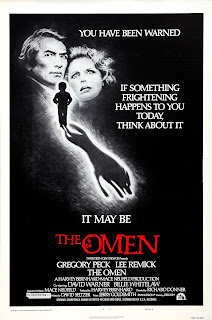
Robin Wood compared The Omen (Richard Donner, 1976) unfavorably to The Texas Chainsaw Massacre, stating that the latter "achieves the force of authentic art" (84). Of this I have no doubt. Chainsaw is an infinitely more effective horror film, genuinely terrifying if not scarring. The Omen is somehow both glossy and shoddy. Plenty of money was thrown around. But too many of the scares derive from cheap reaction shots of agitated zoo animals.

And yet I much prefer The Omen because I don't want horror to be effective. Chainsaw puts me in the position of the victim and because I would rather not be tortured and murdered (I know, right?), the experience of watching the thing is unedifying and irredeemable. By contrast, The Omen is too silly to get under my skin, the threat of a satanic child born of a jackal too far removed from reality to keep me up at night with a knife under my pillow (although the nanny hanging herself at the children's party is as nasty as any scene in Chainsaw). 

Wood also avers that, "The Omen is old-fashioned, traditional, reactionary: the goodness of the family unit isn’t questioned" (79). I find that conclusion baffling since Gregory Peck (typically wooden) kicks off the story with the unforgivable act of not informing his wife (Lee Remick, picking up what I hope was a hefty paycheck) that he has replaced their dead baby with another child. If anything, that affirms the rottenness of the family unit. And they're both awful parents if the scene in which they allow the toddler Damien to wander off is any indication. 

Damien: Omen II (Don Taylor, 1978) was a big disappointment if only because I recall liking it so much as a child (why was I allowed to watch it, though??). But it's pretty creaky overall despite the shocking optics of Lew Ayres, poor thing, under ice (better than over it, e.g., the dreadful Ice Follies of 1939). Omen III: The Final Conflict (Graham Baker, 1981) is the bottom of the barrel with not even a shot of Sam Neill's butt to redeem it.

The Omen: B (Clunky ad copy in the poster below, no? Sounds like something Dick Powell would've came up with in Christmas in July.)

Damien: Omen II: B-minus

Omen III: The Final Conflict: D+

P. S. I'm not watching Omen IV or any of the remakes for the foreseeable future. 

Robin Wood, Hollywood From Vietnam to Reagan and Beyond, (New York: Columbia UP, 2003).


Labels: , ,

Thursday, October 28, 2021

Four trauma-horror films

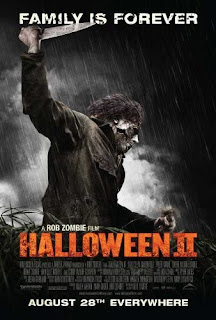
Stories centering on trauma have the potential to inject some complexity into horror/slasher flicks. In a genre where so many characters are slaughtered quickly and damn near anonymously, a film that focuses on the aftermath of surviving Jason or Freddy could be a welcome salve. But first and foremost, a genre pic has to deliver the genre-pic goods. So awful films like Halloween Kills (David Gordon Green [the contemporary Hollywood director with the most squandered career potential?], 2021) and Halloween II (Rob Zombie, 2009) constantly pull away the focus from the trauma story to revel in, wait for it, the quick and anonymous slaughter of characters.

Halloween Kills is particularly repulsive in this regard. Whatever weightiness may have been gained in the survival story (and not too damn much of that given the corny script co-written by Green and Danny McBride) is utterly extinguished by the exigency of requiring Michael Meyers to torture and slaughter a cast of hastily dispatched minor characters. And hooray for progress - an elderly interracial couple, a gay male couple, and a teen boy who wears a dress are all murdered after their allotted five minutes of screen time.

I've been told for years to watch the director's cut of Zombie's Halloween II and have fielded all sorts of claims for it. It's a de facto experimental/avant-garde film financed by Hollywood. It's neorealist. It's a profound mediation on class and trauma. It's one of the best films period of the 21st century. Me, determined to climb whatever mountain of drugs these people were on, I made it halfway through my second screening until my stomach could no longer take it. 

There's a level of commitment here lacking in Green's disaster. But again, Zombie must linger on ever-gorier murder which leaves less time to develop the trauma story, a story that offers little insight into trauma to begin with. And even more time is wasted during each slaughter since Michael (a dead ringer for Rob Zombie this time out) is beset by visions of his mother and his younger self carting around a white horse and imploring him to kill. I presume these are the putative experimental portions of the film. But Zombie tethers these visions tightly to Michael's point of view so that dream and reality are neatly compartmentalized according to the dictates of conventional continuity form. As such, the story remains drearily straight-forward. Then there's the godawful psychobilly band that plays not one, not two, but three (3!) songs (or so it felt like) in a late-second-act party scene. ARGH! 

And for those who couldn't care less about compelling stories of trauma and will brook no complexity or weightiness in their slasher flicks, I get it. I adore the time-wasting spontaneous outbursts of song in musicals and sex scenes in pornography; you dig the gore in slasher flicks (this is to leave out avant-garde films which are nothing but wastes of time to most moviegoers). And as with porn, the ante with gore must be perpetually upped. I applaud cream pies and speculum porn and my beloved The 1,000 Load Fuck (more info here and obviously NSFW!); you applaud a dying woman forced to watch Michael jam every knife in the kitchen into her already dead partner's back. And with all the seriousness I can muster, if such a scene helped you through any trauma, I think that's great for you. Hell, I'll even support federal funding for Halloween Kills in that case.

But I've done my due diligence with this genre and I can do so no longer. Life is nasty, brutish, and short and I still think the vast majority of horror/slasher flicks add horror to the world rather than illuminate or mitigate it. I still think they make the basest fundamental attribution errors, catering to a populace that finds the murder of eight people fascinating or even sexy but the murder of 8,000 unworthy of contemplation (a tendency satirized venomously in the terrific Hulu series Only Murders in the Building). I still think they're soul-draining and reactionary in their dread of difference and sexuality. I still find attempts to conceive of the final girl as a feminist hero risible and unimaginative. You have your prejudices and blind spots. I have mine. Allow me them, i.e., suggesting I see the theatrical cut of Zombie's Halloween II would be a sadistic act indeed. 

By glorious contrast, Lamb (Valdimar Jóhannsson, 2021) and Titane (Julia Ducournau, 2021) are both horror films (also a slasher film in Titane's case!) that concern the trauma of losing a child but respect that narrative by diving deeply into each respective story, revealing myriad facets to the trauma along the way. Where the Halloween films are mind-numbingly paint by numbers, Lamb and Titane are outrageous and unpredictable. Therefore, I won't reveal any spoilers here. But both remind me of the most moving moment of my favorite television show, The Simpsons

In the 1997 episode "The Principal and the Pauper," Principal Skinner is revealed to actually be one Armin Tamzarian after the real Seymour Skinner arrives in Springfield. A flashback explains that Tamzarian and Skinner were in the Vietnam War together. When Skinner is missing in action and presumed dead,  Tamzarian comes to tell Skinner's mother Agnes the news. But instead, he pretends to be Skinner. Remarkably, Agnes pretends along with him. She tells him to go to his room and whispers, "Upstairs. Third door on the left." This was the apex of American postmodernism in the 1990s, positing that fakery and persona play were an unavoidable fact of life.

Similarly, Lamb and especially Titane are about the necessary lies we tell ourselves just in order to wake up in the morning (in this respect, they resemble M. Night Shyamalan's typically brilliant and consistently surprising Apple TV series Servant). Each story turn, no matter how preposterous, houses a touching moment in which damaged characters make do and still wind up making deadly mistakes. And because there is no need to keep a franchise alive with an indestructible murderer, Jóhannsson and Ducournau can afford to spend some time situating the madness into the textures of daily life. The characters and their milieus are given their due rather than their stories coming at us in half-assed chunks in between bouts of Michael Meyers' supernatural prowess.

A colleague recently warned me never to let anyone try to tell me films like the titles in the Halloween franchise contain some sort of profundity. I am relieved to finally be taking his advice.

Oh yeah and before I blissfully forget them forever, The Empty Man and Malignant sucked too.

Halloween II: C

Halloween Kills: D-minus

Lamb: A-minus

Titane: A-minus


Labels: , ,

Wednesday, September 01, 2021

Candyman (Bernard Rose, 1992)

I avoided this for decades because I assumed it was just another body-shaming, sex-phobic gorefest. Color me stunned that it achieves a stateliness quite uncharacteristic of the genre. The body count is minimal which allows the narrative to focus on semiotics (!) grad student Helen's (Virgina Madsen) investigation of the title folk anti-hero (Tony Todd) terrorizing the residents of Chicago's Cabrini-Green housing project. The film's biggest drawback is the cartoonish depiction of the projects which comes off scarier than the Bates Motel. There is an attempt to imagine the texture of daily ghetto life in the character of Anne-Marie (Vanessa Williams; no, no that one), a single mother trying to raise her infant Tony. But overall, the haunted-house characterization of Cabrini-Green feels designed to play off (and confirm) the unexamined fears of white viewers. And if Helen is the rare narrative-driving, intelligent female protagonist, why do we see her breasts several times and never her husband Trevor's (Xander Berkeley) butt? 100% serious question.

Grade: B+

P. S. Dig the poster below. The scariest film since...last year???


Labels: ,

Monday, August 16, 2021

The Amityville Horror (Stuart Rosenberg, 1979)

The Amityville Horror is a horribly written film. In an unexpected preview of writing in the Peak TV era, events shine with such diamond-cased episodicity that they have no bearing on the narrative encasing it. A toilet burbles up with nasty Texas Tea...and we never hear about it again. A craggy, sniffly dude comes to the back door offering a six pack of beer as a welcoming gift...and we never hear from him again. However, the flapping threads actually work in the film's favor. You feel the Lutz family's disorientation as they weather all manner of supernatural foolishness in the notorious murder house. At 118 minutes, it's far too long. And poor Rod Steiger looks totally lost as a beat-down priest. But this improbably popular horror flick, the number two box office champ of 1979 behind, ugh, Kramer vs. Kramer, is much better than I remembered. Trivia: screenwriter Sandor Stern wrote and directed the creepy Pin (1989) and three of his four sons formed the hardcore-punk band Youth Brigade.

Grade: B


Labels: ,